Amanda Jantzen • July 7, 2026
TL;DR
- Google added Search generative AI performance reports to Search Console on June 3, 2026, showing how often your pages appear inside AI features, separated from regular search (Google Search Central).
- It covers generative AI in Search (AI Overviews and AI Mode) and in Discover, with impressions, the exact pages that appeared, and country breakdowns (Google Search Central).
- It is rolling out to a subset of sites first, starting in the UK, with no global date yet, so plenty of coaches cannot open it today (Google Search Central).
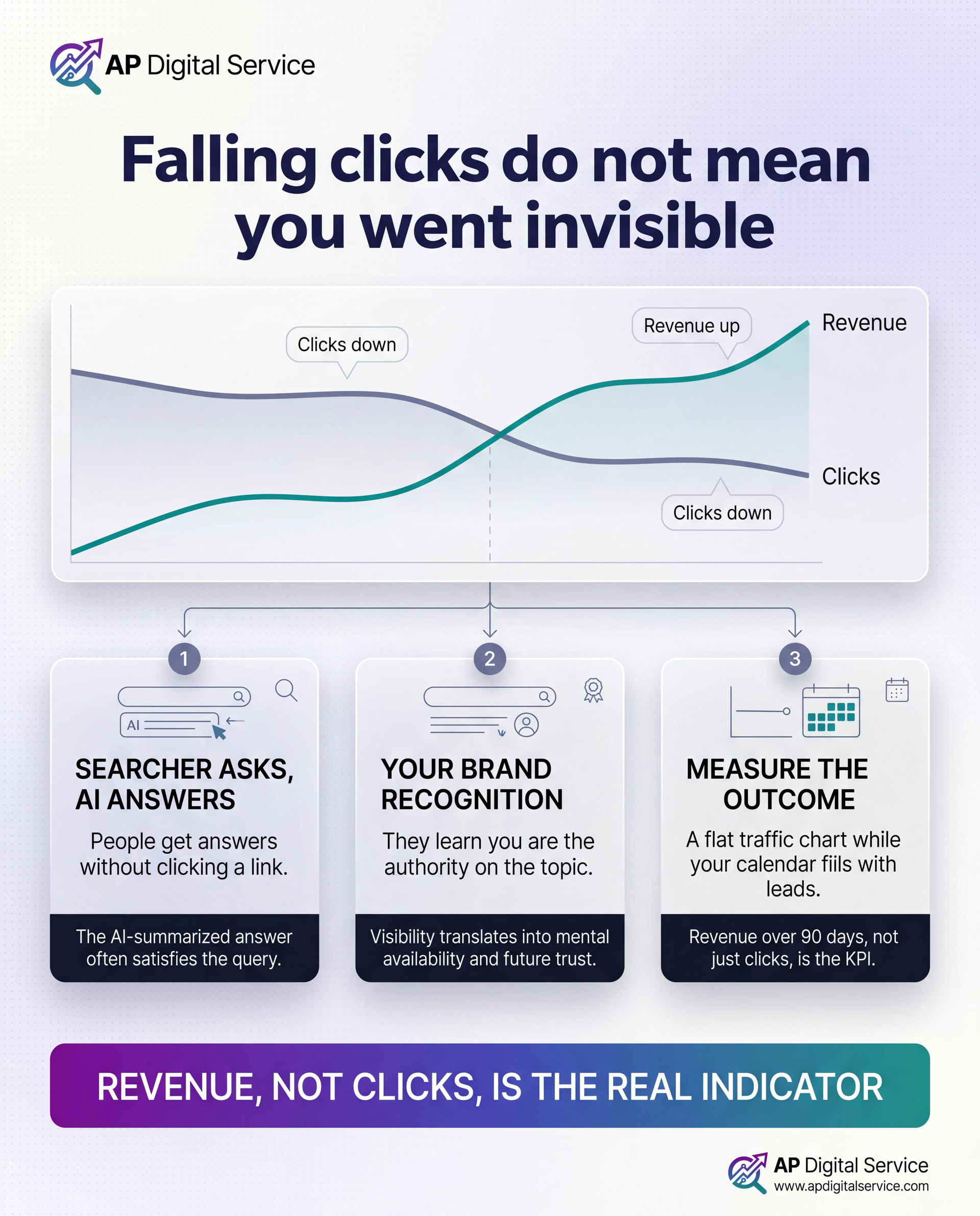
- Falling clicks do not mean you lost visibility. If revenue is climbing while clicks slow, you are likely being cited in AI and buyers are finding you without the click.
- There is a new toggle to block your content from AI Overviews, AI Mode, and Discover AI. Opting out forfeits AI traffic and impressions and does not change your regular ranking (Google Search Central). For most coaches it is the wrong button.
Google now shows you how often your coaching site gets pulled into AI answers, in its own report inside Search Console. It went live on June 3, 2026. The first thing most coaches will do with it is misread it. They will see clicks dip, assume they have gone invisible, and panic.
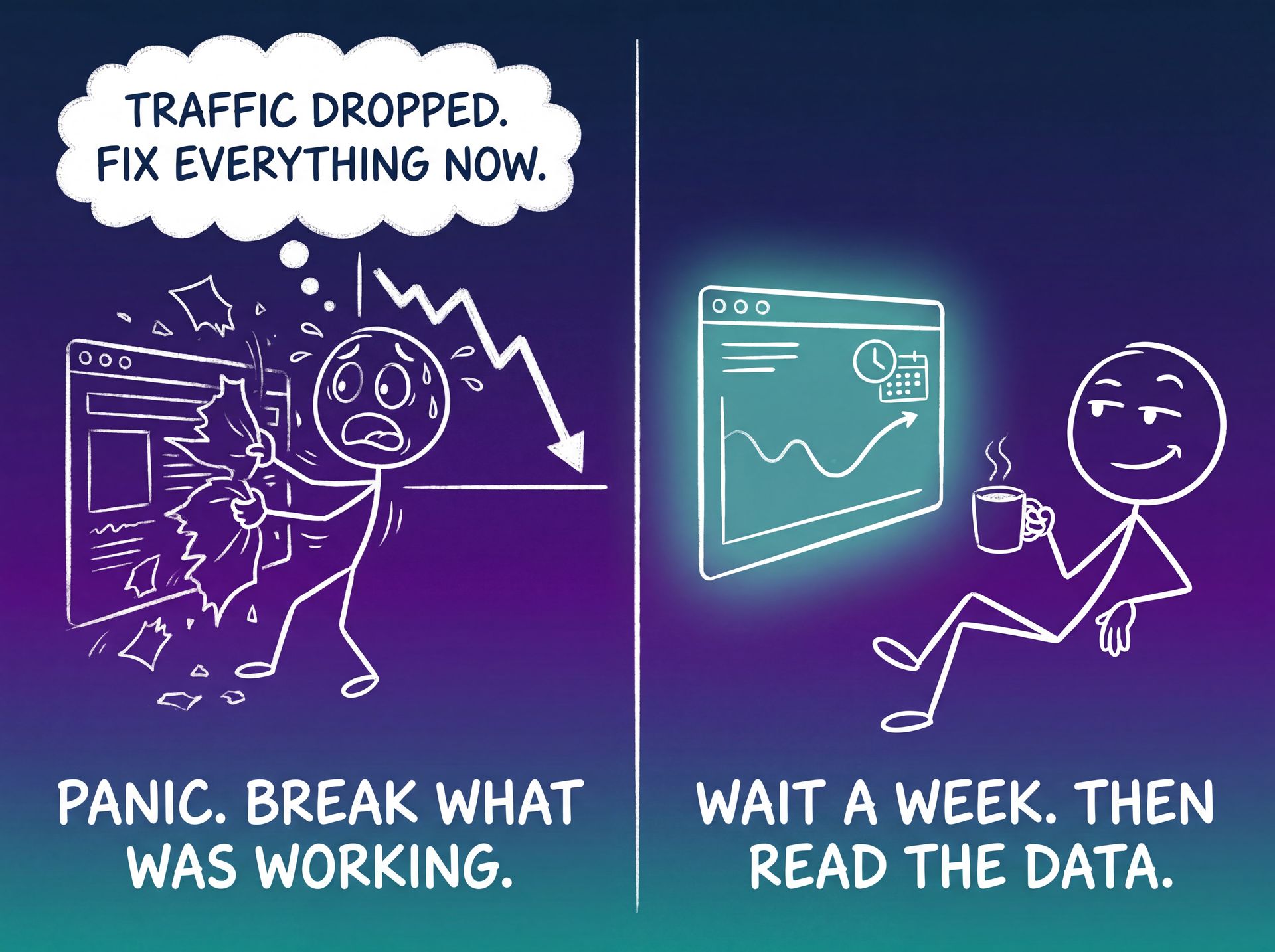
Your clicks slide, your stomach drops, you assume the worst. Reasonable. Also, often wrong. A click drop can be the sign the new thing is working, not breaking.
What is the new Search Console AI visibility report?
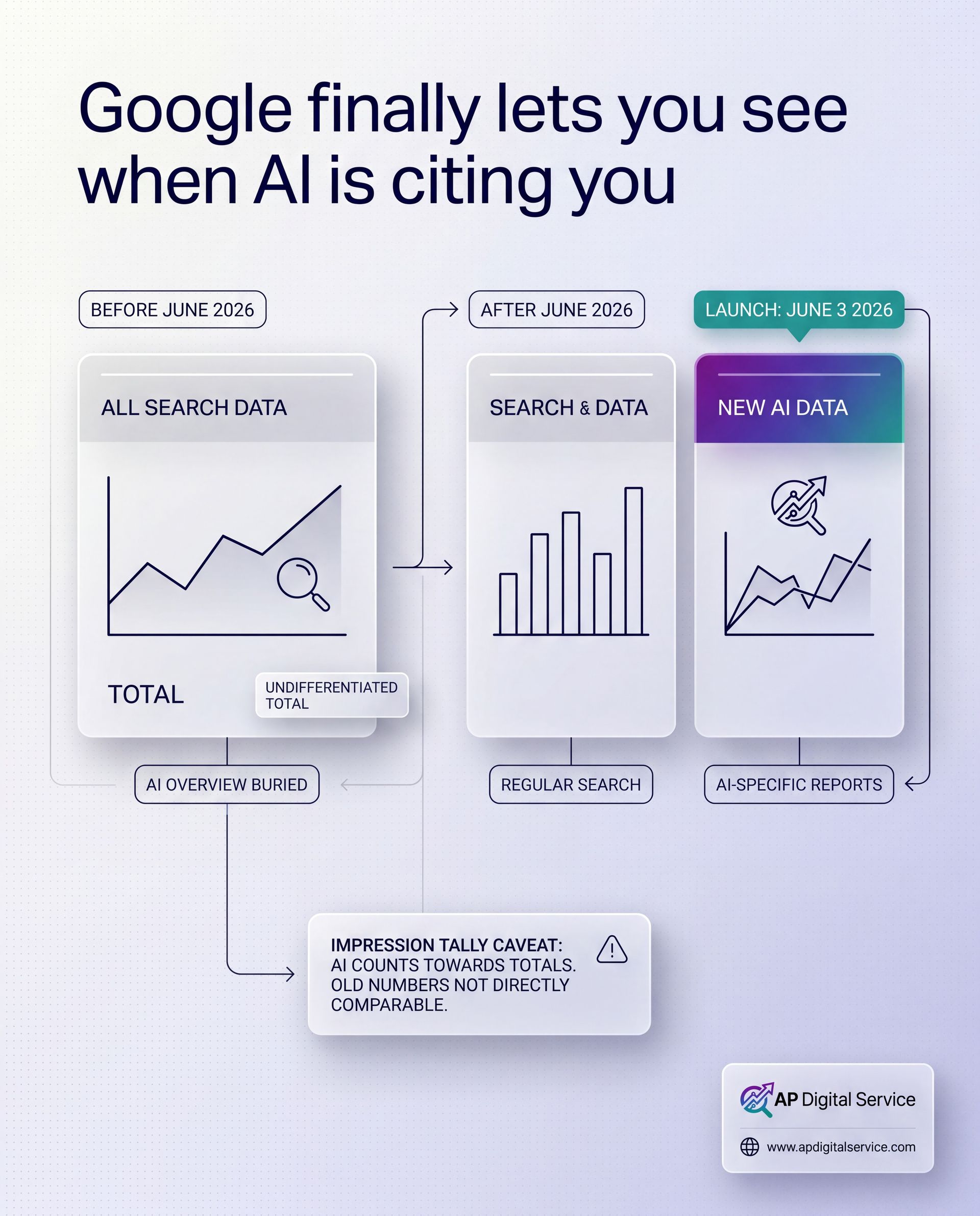
It is a separate view inside Google Search Console, one of the new dedicated reports for site owners, that shows how often your website appears in AI-generated search experiences, kept apart from your regular search numbers. Google calls them the Search generative AI performance reports, and they went live on June 3, 2026 (Google Search Central).
Here is why that matters. Before this, when one of your pages got pulled into an AI Overview, that activity was blended into your normal Search Console totals and you could not separate it. So every coach who has been told for two years that AI search matters has been guessing about whether it was doing anything for them.
This is a huge step for site owners and SEO professionals, because it finally puts AI data in its own separate view, next to traditional search performance, instead of burying it inside regular results. It gives a cleaner read on organic performance too, even though Google Analytics still rolls that visit up as google / organic and tells you little about the user behind it. That is useful for your SEO strategy, your content strategy, and the wider reality that search now lives partly outside your own site.
One catch worth knowing: AI Mode impressions now count toward your overall Search Console totals, so the numbers you saw before June 3 are not directly comparable to today's.
What does the AI visibility report actually show?
It shows impressions, broken down five ways: how often your pages appeared inside AI features, which exact pages appeared, and the countries, devices, and dates those impressions came from, at anywhere from hourly to monthly granularity. It spans AI Overviews and AI Mode in Search, plus generative AI features in Discover (Google Search Central). The data goes back to May 18, 2026, with no backfill before that, so there is a little history to read, not only today forward.
At a glance:
| What you see | What it tells you | What a coach does with it |
|---|---|---|
| AI impressions | How often a page showed up inside an AI feature | Confirm AI search is surfacing you at all |
| Pages tab | The exact URLs appearing in AI responses | Protect and expand your few citable pages |
| Countries and devices | Where and how those impressions came in | Check the audience matches your buyers |
| Dates | Hourly through monthly granularity | Track your AI overview traffic over time |
The Pages tab is the one to sit with. It identifies the exact URLs appearing in AI responses, and it tends to be a short list, because one answer-first article usually carries most of a coach's AI presence while the rest of the site stays quiet. If one page shows high impressions in AI and another shows almost none, you have a measurable gap and a clear place to put your effort.
Now the part that trips people up. For now these reports show impressions only. No clicks, no CTR, no average position, and no query-level data, so you will not find a queries tab or a date-range comparison of clicks the way you would in the standard Search results report. Google has said additional metrics will come over time, with no firm date. The data also lives only in the Search Console interface for now, not the API, so you cannot pull your AI impressions into a spreadsheet or dashboard automatically yet. None of this is glamorous. It is just the first time you get to stop guessing.
Can every coach open this report right now?
No, and that is not your fault. Google is releasing it to a subset of website owners first, starting in the UK, and has not announced a global date (Google Search Central). I went to pull it up for this post and could not get in yet, because access has not reached our account. That is how Google handles a limited rollout.
So if you open Search Console today and the report is not there, you have not broken anything and you are not behind. It is coming. I will update this post with real screenshots the moment our account gets access, because a walkthrough of the real thing beats me describing something I have not opened.
Why do my clicks drop while my business grows?
Because you are getting cited in AI, and citations do not always come with a click. This is the part I walk every coach through: revenue is the real indicator. If revenue is climbing while your clicks slow down, read that as a sign you are being named in AI answers, not a sign you vanished.
Think about how people search now. They ask, and the AI answers inside the result, so they get what they needed without clicking a single blue link. They still saw your name. They still learned you are the one who handles this. Your traffic chart looks flat. Your calendar does not. A coach who only watches clicks will misread the biggest change in search and try to fix something that was never broken. This is also why it is worth knowing how to read normal volatility before you react to it, which is exactly what we covered in our breakdown of the May 2026 Google core update for coaches.
The wider data backs this up. AI Overviews now appear on close to half of tracked queries, and that share keeps climbing (BrightEdge, 2026). Click-throughs to regular results have fallen since AI Overviews arrived, by roughly 30 percent on tracked content overall (BrightEdge), and individual studies report AI Overview click-through drops anywhere from 15 to 89 percent depending on the query and the position. And ranking and getting cited are pulling apart: Ahrefs found only 38 percent of AI Overview citations now come from pages in the top 10, down from 76 percent a year earlier (Ahrefs, 2026). You can be the source an AI answer is built from without sitting at the top of page one. The old scoreboard was how many clicks you got. The new one is how often you are surfaced in AI answers.
It also pays to write for how people ask now, because Google's own March 2026 data shows AI Mode queries run two to three times longer than traditional searches, which means longer, more conversational, more specific questions.
A real example: the numbers said decline, the business said grow
I had a coaching client watching their numbers slide, and they were confused, because business was picking up at the same time. On the chart it looked like something was failing. It was the opposite.
When we dug in, we showed them they were getting AI Overview traffic and that AI was actively recommending them, even as their traditional search performance looked weaker. The report had been hiding the win the whole time. That one conversation flipped how they saw it, and it is the exact misread this new report exists to prevent. We have watched the same pattern turn into booked clients before, like the career coach who landed five high-ticket clients without a launch. The report does not change the truth. It just finally shows it to you.
Should coaches use the new button to block AI?
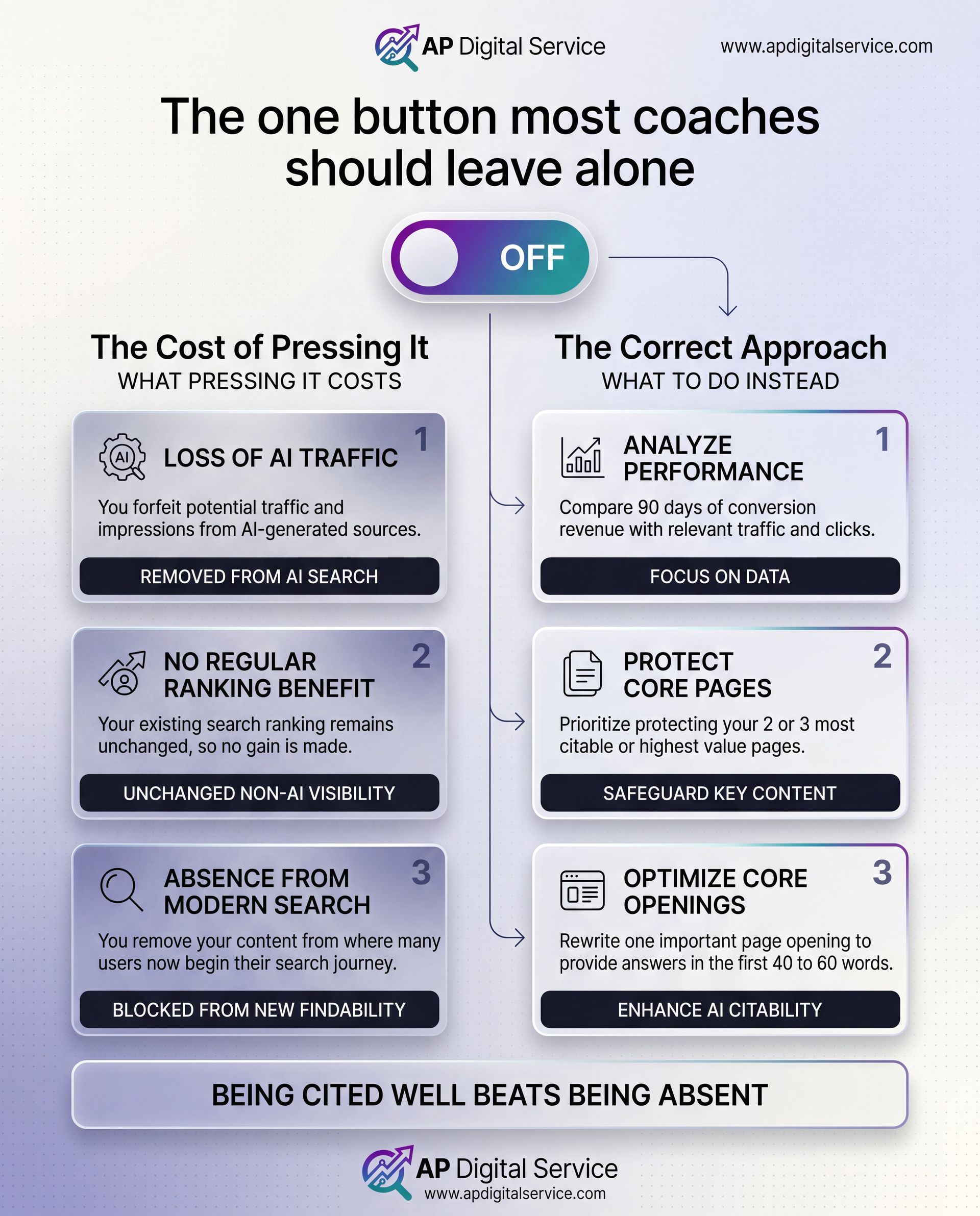
For almost every coach, no. The announcement shipped a control that blocks your content from AI Overviews, AI Mode, and Discover AI. Use it and you forfeit the AI traffic and the impressions, though it leaves your regular ranking alone (Google Search Central).
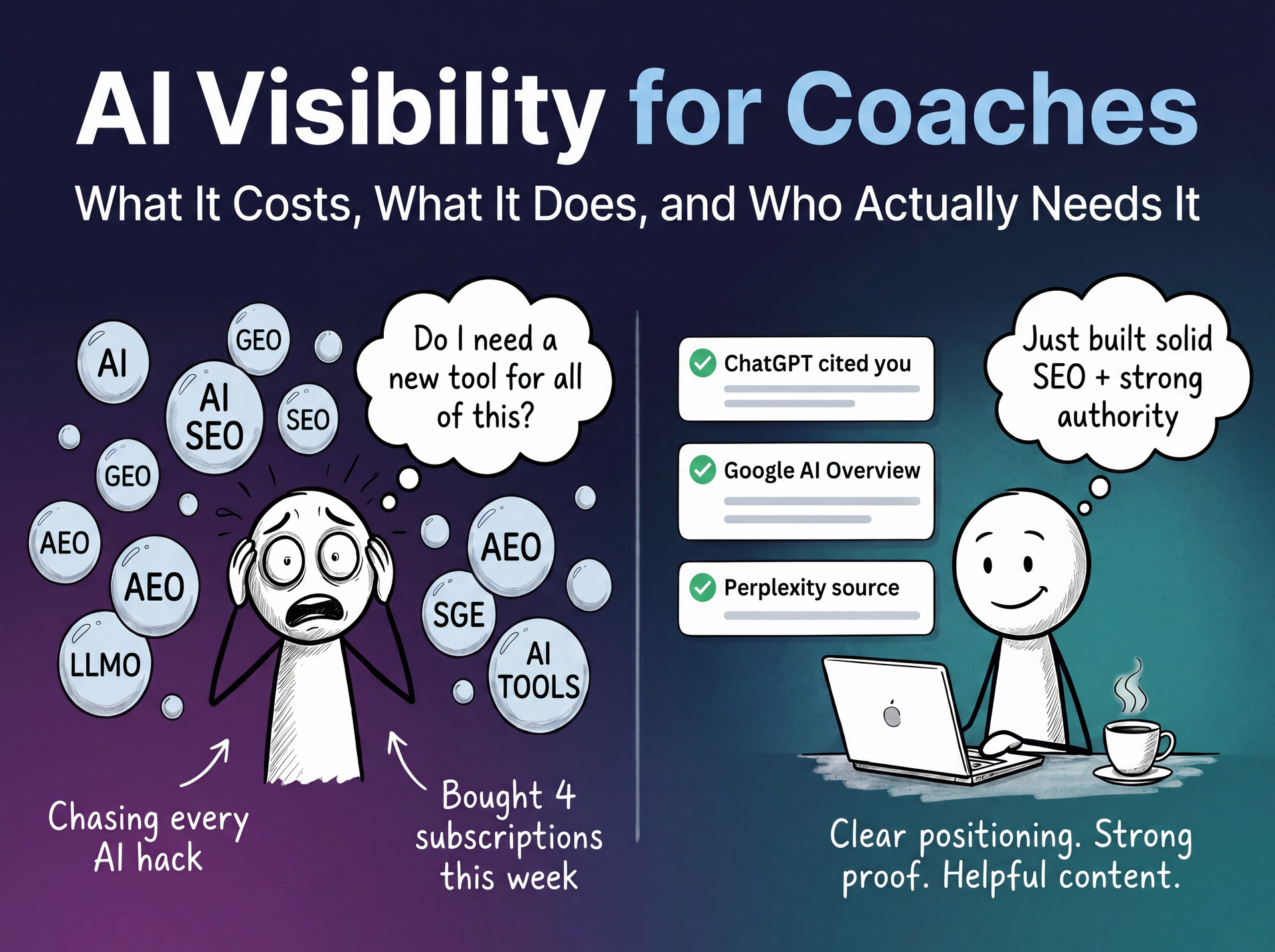
I understand the urge, especially if AI feels like it is eating your clicks. But blocking yourself removes you from the place more and more people start their search, right as it becomes the front door. You would be opting out of the recommendation engine to protect a click count that matters less every month. Being cited well beats being absent. Do not press the button because a chart scared you. If you are weighing whether AI visibility is worth the effort at all, we wrote a plain breakdown of what AI visibility costs and who actually needs it.
How does this connect to actually getting found, not just measured?
Seeing your AI presence is step one. Earning more of it is the job. AI lifts answer-first passages from pages it can read and trust, so the work that earns citations is the same work that earns rankings: a clear answer near the top, real expertise on the page, schema that tells AI who you are and who you serve, and strong images or video that raise your odds of being selected. That is also why we treat search and AI as one system rather than two, which we explain in how SEO and AI visibility work together for established coaches.
This is the spine of our Full-Funnel Search System, the way we make a coaching business findable across Google search, AI search, and ads, and it should shape your content strategy. SEO for coaches stopped being about ten blue links a while ago. It is about being the source the answer gets built from, which is the heart of what actually earns AI search visibility for coaches. The new report is just the first time Google has let you watch it happen in your own account.
What to do this month
- Open Search Console and look for the new Search generative AI performance report. If it is not there, do not worry, access is still rolling out (Google Search Central).
- Put your last 90 days of revenue next to your clicks and impressions. If revenue is up while clicks are flat or down, log that as AI visibility working, not a problem to solve.
- Find the two or three pages that already answer a real, buyer-specific question in the first few lines. Those are your most citable assets, so protect them.
- Leave the AI block toggle off unless you have a specific, deliberate reason to opt out.
- Take one core service page or post and rewrite the opening so it answers the question in the first 40 to 60 words. This also helps with the longer, more conversational queries people type into AI Mode.
These overlap with what we check in a Visibility Review, and with what actually drives qualified leads from SEO for coaches, because they decide whether you get surfaced at all.
Frequently asked questions
What is the Search Console AI visibility report?
It is a separate view in Google Search Console, launched June 3, 2026, that shows how often your site appears inside Google's AI-generated search experiences, kept apart from regular search results (Google Search Central ).
What does the AI visibility report show?
It shows impressions inside AI features, the specific pages that appeared, and the countries those impressions came from, across AI Overviews, AI Mode, and Discover (Google Search Central). It lets you compare AI visibility against traditional web traffic in one place.
Why are my clicks dropping but my business is growing?
Because you are likely being cited in AI search. The AI answers the searcher inside the result, so they may not click, but they still learn who you are. Watch revenue, not only clicks, to read AI visibility correctly, and compare impressions and clicks over the same date range.
Can I see the report in my account today?
Maybe not. Google is releasing it to a subset of sites first, starting in the UK, with no global date announced, so many accounts do not have it yet (Google Search Central).
Should I block my coaching content from AI?
For most coaches, no. Opting out forfeits AI traffic and impressions and removes you from where buyers increasingly start, even though it does not change your regular ranking (Google Search Central).