April 7, 2026
TL;DR
- AI search visibility for coaches is growing in importance as more potential clients use AI tools, AI assistants, and Google AI Overviews to get direct answers.
- Key Point #1: AI visibility is built on the same foundation as strong SEO — technical SEO, internal linking, optimized pages, useful content, and authority signals.
- Key Point #2: Blog content is not just for traffic; it can become a visibility asset that helps coaches get cited in AI search results.
- Key Point #3: AI visibility matters most when it is tied to a conversion-ready website that turns discovery into inquiries, applications, and revenue.
- The Full-Funnel Search System matters because AI and traditional search visibility works best as part of a broader strategy that connects search, trust, and conversion.
- Common mistakes include relying only on social media, using generic website copy, treating AI as separate from SEO, and failing to build proof or track performance.
- Main takeaway: AI search visibility is not a shortcut. It comes from building enough trust, relevance, and authority for search engines to confidently surface your business.
Introduction
AI search visibility for coaches is becoming a bigger part of how potential clients discover who to trust, who to click, and who to inquire with next.
That matters across niches, from executive coaching to career coaching to health and performance coaching. Search behavior is shifting toward direct-answer experiences. Studies from Pew, Bain, and McKinsey suggest users are increasingly relying on AI summaries, AI assistants, and AI-powered search tools like Google AI Overviews instead of browsing traditional result pages the way they used to. In many cases, they are not typing a vague keyword into search engines anymore. They are asking long, specific, intent-rich questions and expecting fast, relevant, AI generated answers.
For coaches, that changes the game.
The brands that earn AI visibility are often the ones that make it easiest for AI systems and people to understand who they help, what they do, and why they are credible. That means ai search visibility is no longer just a nice-to-have. It is now part of a modern content strategy, search visibility strategy, and trust-building strategy for service-based business owners. At AP Digital Service, this is one part of what we build through The Full-Funnel Search System, our approach to turning search visibility into trust, inquiries, and revenue for coaches.
We have seen this firsthand. Our experience shows that coaches do not get cited by AI search platforms because they published a few trendy posts. They get cited after their site becomes structurally sound, their messaging becomes clearer, and their content consistently answers the same category of problems while providing value upfront. This lived experience matches the case study we documented for Broda Coaching and Better Work, where strong blog content, technical SEO, internal linking, and website improvements helped drive page-one Google visibility, appearances in Google AI Overviews, and significant revenue influence.
Why Do AI Search and AI Platforms Matter for Coaches?
People are using AI search in a more direct way than they use Google and traditional search engines. Instead of browsing ten links, they ask questions like:
“Who is the best career coach for senior-level professionals?”
“Which coach helps with career transitions?”
“Who should I hire if I want a coach with a proven framework?”
That shift matters because AI responses often synthesize multiple sources into one recommendation. A coach may win attention before a user ever visits a full page of search results. That is one reason brand mentions, brand visibility, and a brand’s presence across a website, directories, reviews, and other platforms are becoming more important.
For coaches and individual trainers, this creates both opportunity and risk.
The opportunity is obvious: if your brand appears in AI generated responses, you can earn trust earlier and improve online visibility with high-intent users.
The risk is just as real: if your website, profiles, and expert content are thin, inconsistent, or unclear, AI models may pull from other platforms, other sources, or more established competitors instead.
AI Search Visibility for Coaches Starts With SEO Authority
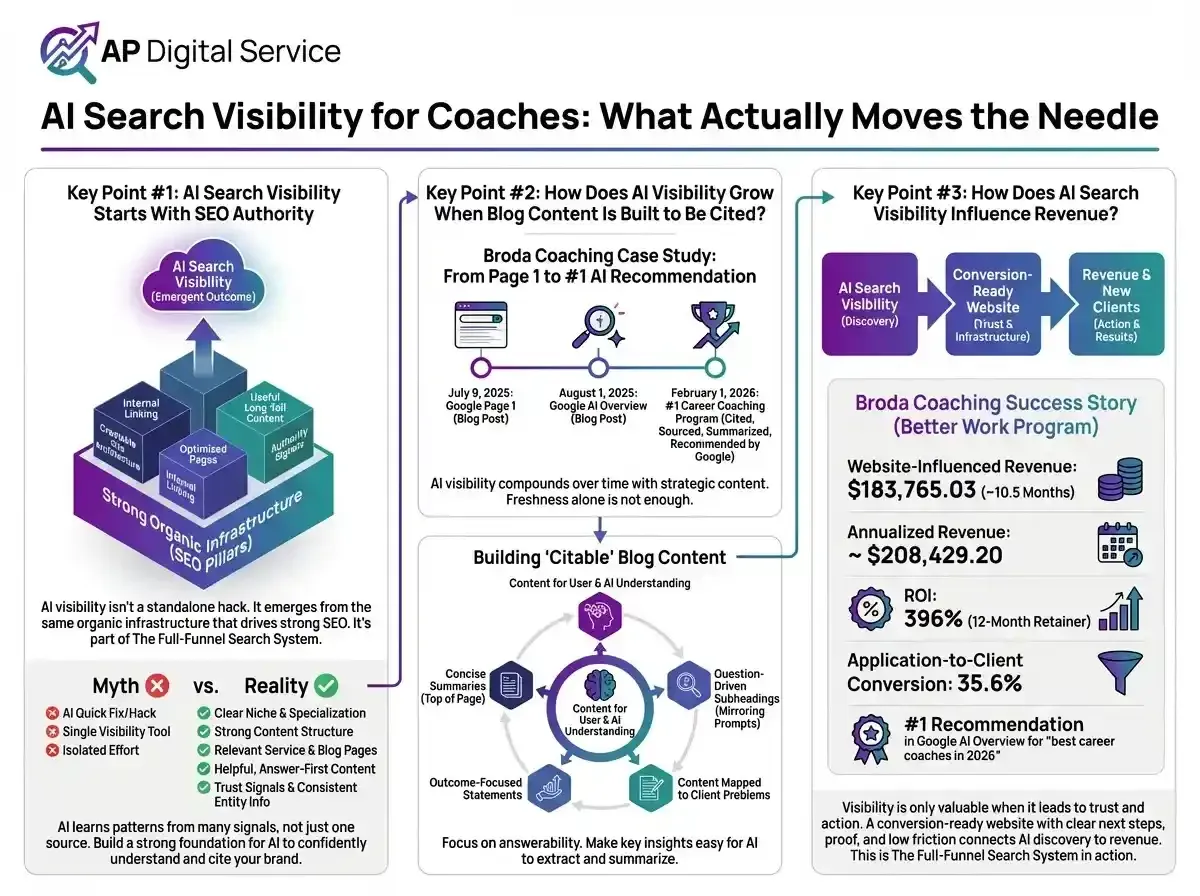
AI search visibility is built on the same authority systems that drive strong SEO.
Our experience is consistent with what Google and industry studies support: AI visibility does not happen in isolation. It tends to emerge from the same organic infrastructure that drives strong SEO: crawlable site architecture, internal linking, optimized pages, useful long-tail content, and authority signals that help search engines confidently understand and cite your brand in AI-powered results. In practice, AI search visibility for coaches is an outcome of strong organic infrastructure, not a separate hack.
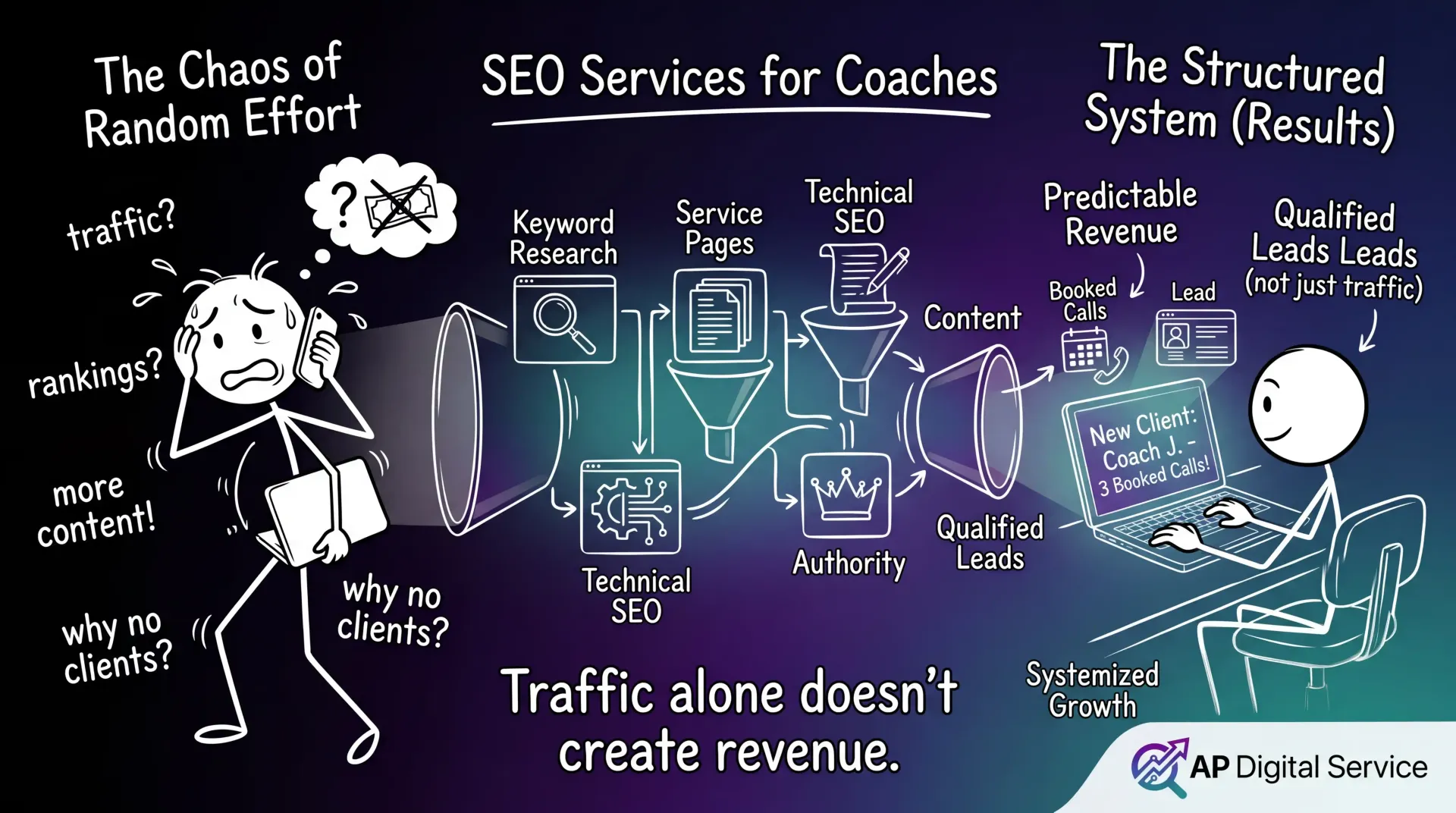
That is exactly why AI search visibility is part of The Full-Funnel Search System. We do not treat it as a standalone tactic. We treat it as the result of stronger search foundations working together across technical SEO, site structure, content, authority, and conversion.
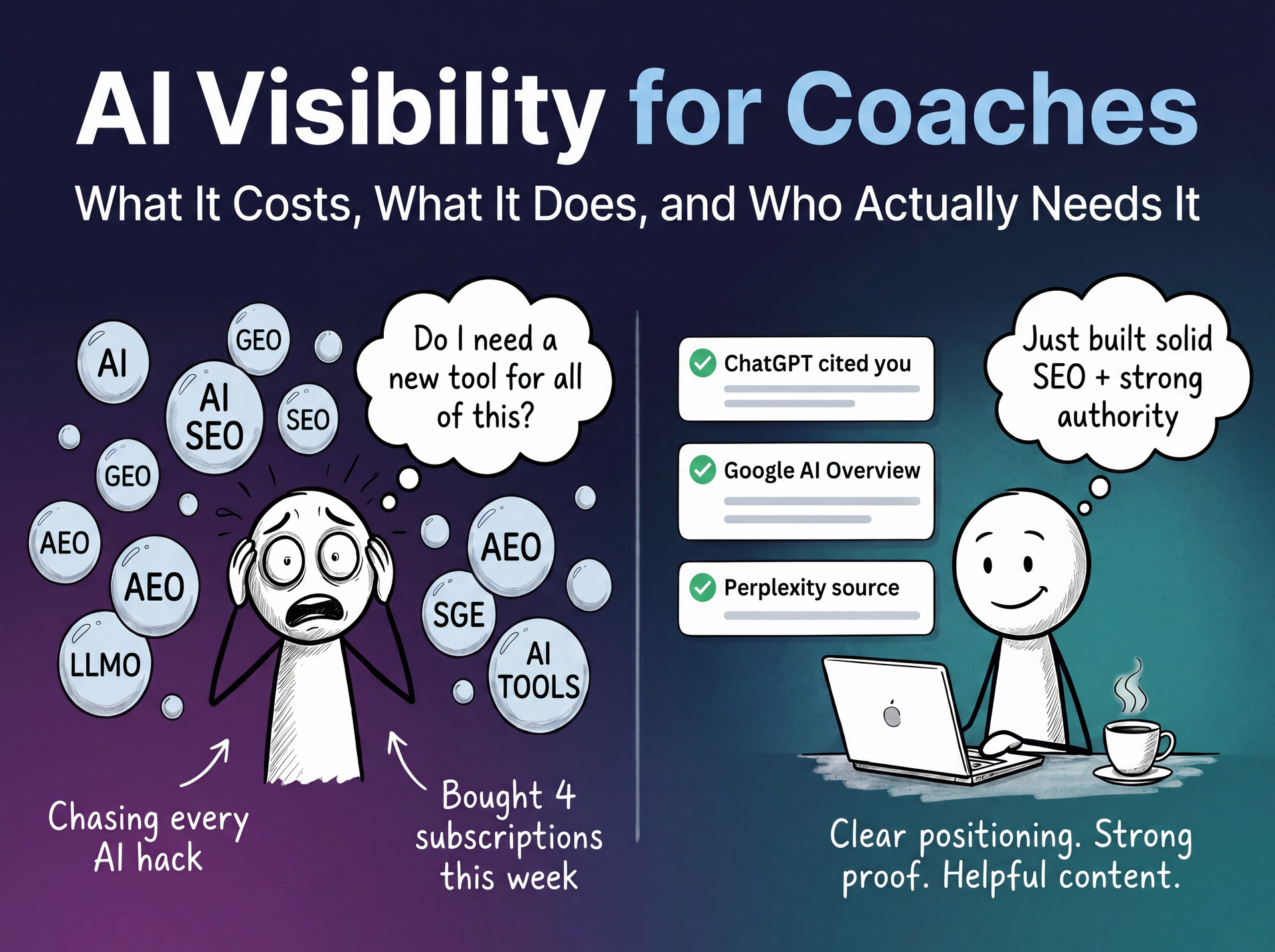
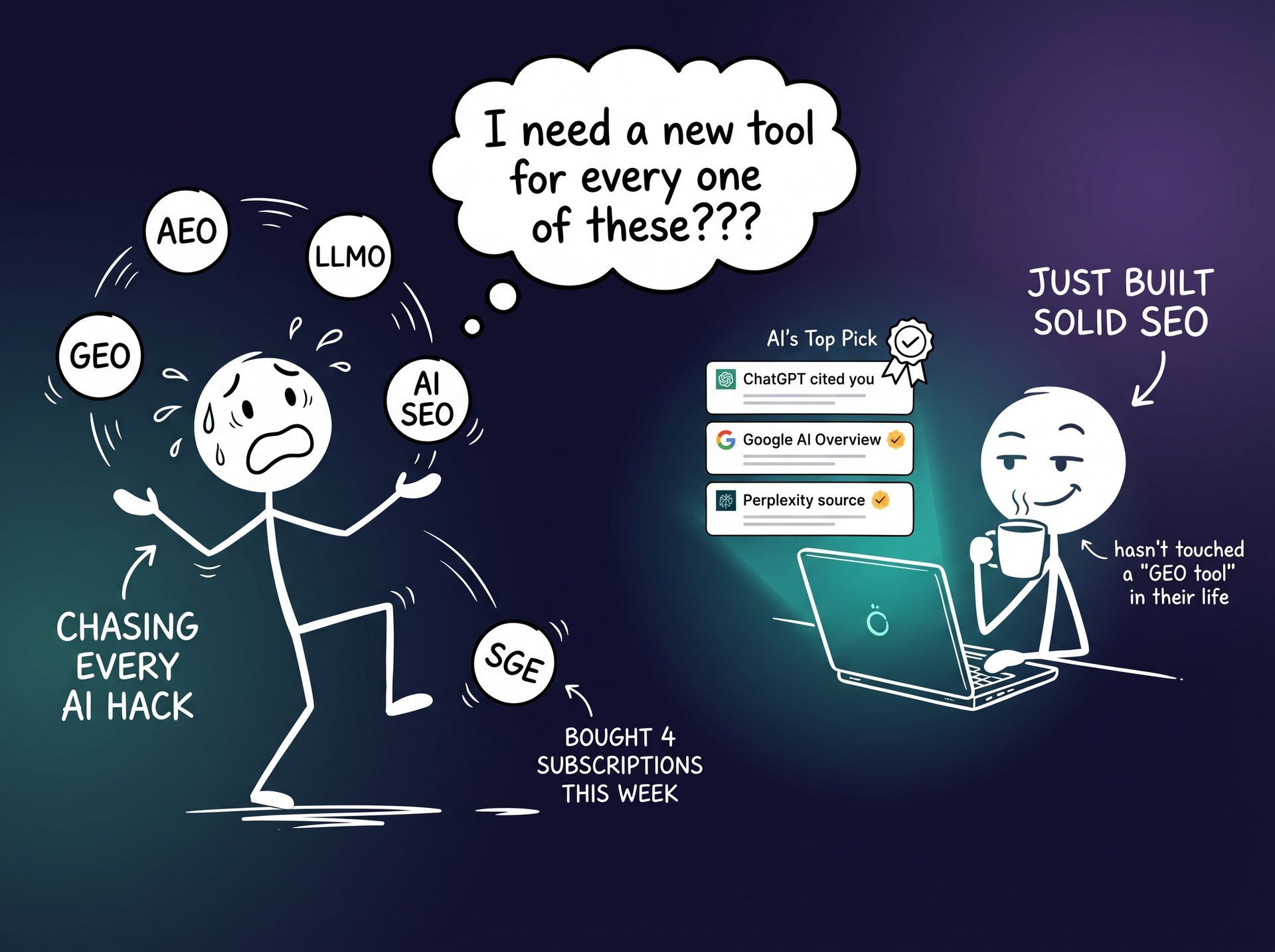
That is an important correction to how many people currently talk about AI. A lot of talk about AI platforms makes it sound like there is a single AI search visibility tool or quick fix that can force recommendations. But what AI systems seem to reward is much closer to what strong traditional SEO has always required:
- A clear niche and specialization.
- Strong content structure.
- Relevant service and blog pages.
- Helpful, answer-first content.
- Trust signals across the web.
- Consistent brand and entity information.
This is also where many coaches get tripped up. They assume AI is learning from one single source. It is not. AI learns patterns from many signals, including your site architecture, your expert content, your internal link structure, your brand mentions, and how clearly your site matches intent. Even the way your person and business identity are understood across systems can affect visibility.
How Does AI Visibility Grow When Blog Content Is Built to Be Cited?
Blog content plays a major role in earning AI search visibility.
In our work, blog posts are not just traffic assets. They become visibility assets inside search, AI overviews, and other AI search platforms.
Our Broda Coaching case study gives a useful timeline. Broda Coaching first appeared on page 1 of Google with a blog post on July 9, 2025. The brand then first appeared in Google AI Overview with a blog post on August 1, 2025. Later, Broda Coaching earned a #1 organic result with a blog post and was ultimately cited, sourced, summarized, and recommended by Google as the #1 career coaching program for 2026 for a broad search term on February 1, 2026.
That progression matters because it shows what strong AI search visibility often looks like in real life. It is not random. It compounds.
A useful way to think about it is this:
- Your service pages clarify what you do.
- Your blog builds topical authority.
- Your internal links connect those signals.
- Your case studies and proof increase credibility.
- Your site gives AI answers and direct answers in a format that is easier to quote, summarize, and trust.
In other words, fresh content alone is not enough. The goal is to create content that is easy for both users and AI to understand.
That includes:
- Concise summaries near the top of key pages.
- Question-driven subheadings that mirror user prompts.
- Outcome-focused statements.
- Proof points and social proof.
- Content mapped to recurring client problems.
Coaches who want better AI mentions should build content for answerability, not just for volume. The best-performing assets often make key insights easy to extract. Within The Full-Funnel Search System, this is where content stops being “just blogging” and starts functioning as a visibility and conversion asset.
How to Build Your Website for AI Search Visibility, Not Just Traditional Search
A strong website does more than rank. It helps AI models understand your specialization, validate your credibility, and connect your brand with the right query.
That means a coach’s website should not be generic.
If you want to improve visibility, your site needs clear specialization pages, strong service language, FAQs, and content that directly answers what potential clients ask. It should also have a consistent internal structure so that both people and machines can understand how your offers fit together.
This is exactly what we deliver for our coaching clients through The Full-Funnel Search System. Our work includes website structure, internal linking, content publishing, backlinks, credibility building, and “SEO & AI search readiness.” Note that organic growth should be distributed across blog content, the homepage, and core service pages of your website. This points to sitewide authority of your coaching website rather than one isolated win.
For coaches, that means your website should help AI answer questions like:
- Who is this coach for?
- What problem do they solve?
- What outcomes do they help clients achieve?
- What proof supports those claims?
- Why is this coach a relevant recommendation over competitors?
This is also where structured entity signals matter. Clear Person references, consistent naming, service descriptions, and relevant platform profiles help reduce confusion across systems. Even though many people focus on flashy AI tools, the better move is usually to strengthen your actual website and digital footprint first.
AI Overviews, Brand Mentions, and Brand Visibility
One reason brand mentions matter is because many AI generated outputs synthesize trust from multiple sources.
That means brand visibility is not just about ranking your homepage. It is about building enough corroboration that your name is frequently mentioned in the right contexts and connected to the right expertise.
For coaches, that can include:
- Google Business Profile
- Podcast appearances
- Reputable directories
- Guest articles
- Testimonials and review platforms
- Local and niche citations
- Expert commentary on other platforms
This does not mean coaches should chase every platform. It means they should be intentional about the signals that reinforce credibility.
The stronger your brand’s presence across your site and trusted third-party sources, the easier it is for AI to understand your relevance.
What is AI Visibility Score and What Should be Tracked?
A lot of people want one clean number. That is where an AI visibility score can be useful, but only if it supports strategy.
An AI visibility score should help you track progress, not distract you from the fundamentals.
Whether you use an AI search visibility tool, traditional analytics, or a combination of traditional SEO tools and AI monitoring tools, the goal is to measure the right key metrics:
- How often your brand is cited in ai search platforms.
- Which prompts trigger your AI mentions.
- Whether your competitors are appearing more often.
- What visibility data shows about your share of voice.
- Whether traffic and inquiry quality improve over time.
- Which pages are driving discovery and trust.
- Whether search visibility is translating into leads and revenue.
That last point matters most. Not every mention is valuable. The real question is whether AI visibility is moving the business forward.
How Does AI Search Visibility Influence Revenue?
AI search visibility can influence revenue when it is tied to a conversion-ready website.
From our experience, visibility alone is not the win. Visibility plus trust plus conversion infrastructure is the win.
For example, we achieved $183,765.03 in website-influenced revenue over ~10.5 months for Broda Coaching and its Better Work program, annualized to about $208,429.20, with a 396% ROI on a 12-month retainer. This was made possible by a 35.6% application-to-client conversion rate for applications collected through the website. The Better Work program of Broda Coaching achieved #1 recommendation status in Google AI Overview for “best career coaches in 2026.”
That is the practical point many businesses miss.
You do not need AI search visibility just so you can say your name showed up in AI-generated responses. You need it because discovery should lead to trust, action, and new clients.
A strong conversion-ready website helps close that gap by giving users:
- A clear next step.
- Relevant proof.
- Consistent messaging.
- Stronger credibility.
- Lower friction when they are ready to act.
That is also why we built The Full-Funnel Search System the way we did. AI search visibility is valuable, but only when it is connected to the rest of the funnel.
What are Common Mistakes That Hurt AI Search Visibility?
There are several common mistakes coaches make when trying to optimize for AI.
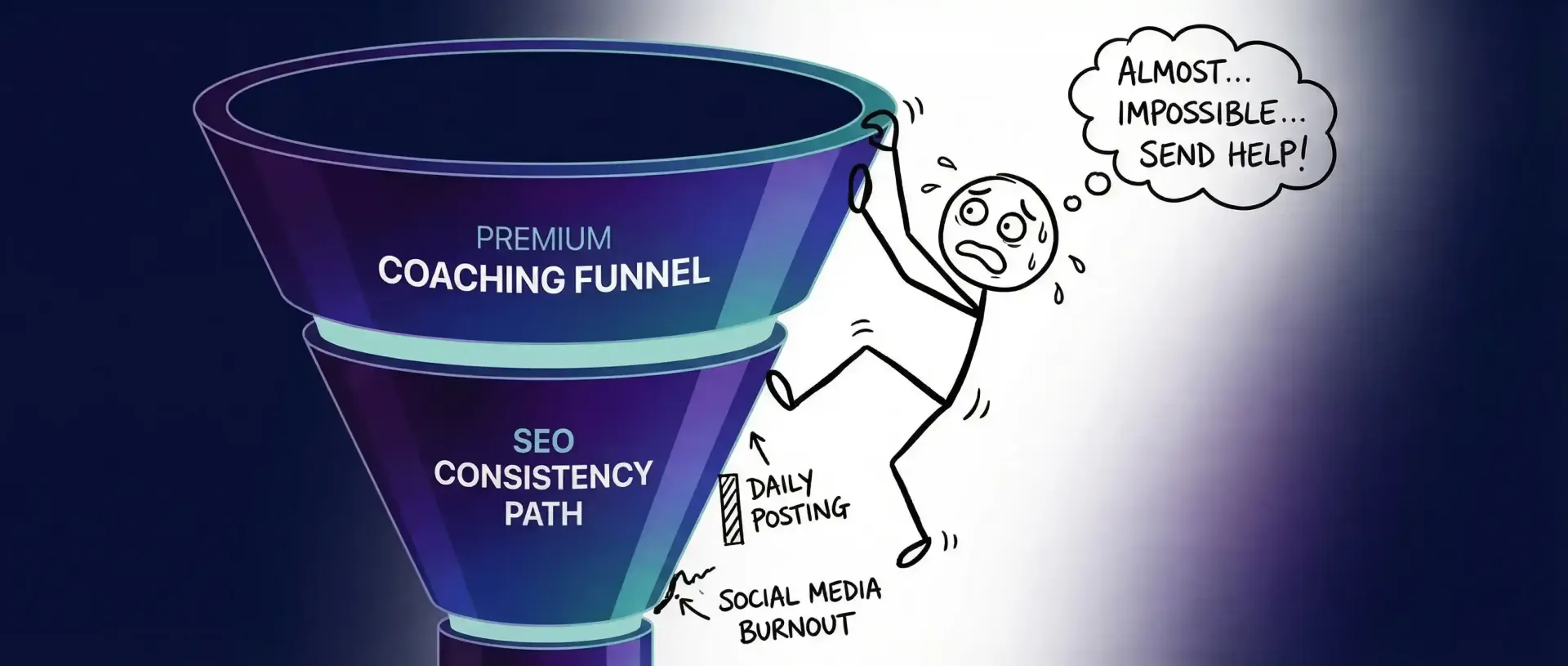
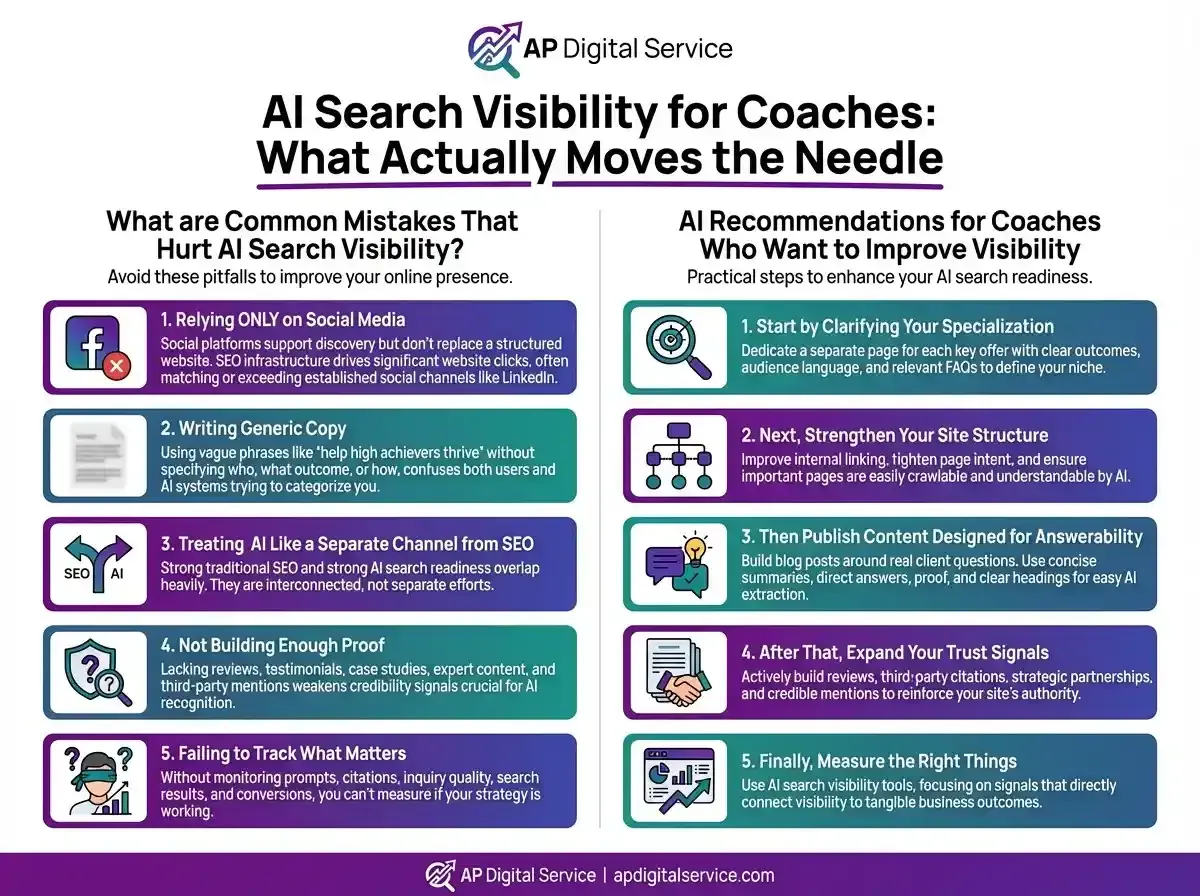
The first is relying only on social media. Social platforms can support discovery, but they do not replace a structured website. From our experience, SEO infrastructure can send as many or more website clicks as LinkedIn, despite LinkedIn being an established channel for the founder over several years.
The second mistake is writing generic copy. If your website says you help “high achievers thrive” but never explains who you help, what outcome you deliver, or how your process works, both users and AI will struggle to place you.
The third mistake is treating AI like a separate channel from SEO. In reality, strong traditional SEO and strong AI search readiness overlap heavily.
The fourth mistake is not building enough proof. Reviews, testimonials, case studies, expert content, and third-party mention signals all reinforce credibility.
The fifth mistake is failing to track what matters. Without monitoring prompts, citations, inquiry quality, search results, and conversion behavior, it is hard to know whether your strategy is actually working.
AI Recommendations for Coaches Who Want to Improve Visibility
Here are practical AI recommendations based on our experience supporting coaches.
Start by clarifying your specialization. Make sure each key offer has its own page with clear outcomes, audience language, and relevant FAQs.
Next, strengthen your site structure. Improve internal linking, tighten page intent, and make sure important pages are easy to crawl and understand.
Then publish content designed for answerability. Build blog posts around real client questions, not just broad keywords. Use concise summaries, direct answers, proof, and clear headings.
After that, expand your trust signals. Build reviews, third-party citations, strategic partnerships, and credible mentions that reinforce what your site already says.
Finally, measure the right things. Use whatever AI search visibility tool or stack makes sense, but focus on the signals that connect visibility to business outcomes.
FAQ
What drives AI search visibility for coaches?
AI search visibility for coaches is typically driven by strong SEO foundations, including technical SEO, internal linking, optimized service pages, useful blog content, authority signals, and a clear website structure.
Why does AI search visibility matter for coaches?
AI search visibility matters because more potential clients are using AI assistants, AI summaries, and AI-powered search tools to get direct answers. Strong visibility can help coaches earn trust earlier and generate more qualified inquiries.
How long does it take to improve AI search visibility for coaches?
AI search visibility usually improves over time as your website becomes more crawlable, your content becomes more useful and structured, and your authority signals grow. It is not an instant win. For most coaches, meaningful progress comes from consistently strengthening SEO, content, and credibility over time.
Is AI search visibility different from traditional SEO?
AI search visibility is not completely separate from traditional SEO. In most cases, it builds on the same foundation: strong site structure, helpful content, clear positioning, internal linking, and authority signals. The difference is that AI platforms often reward content that is especially easy to summarize, cite, and connect to user intent.
The Main Takeaway on AI Search Visibility for Coaches
AI search visibility is not a shortcut. It is the result of building enough trust, relevance, and authority for AI powered search to confidently surface your business.
That is the real playbook.
Not shortcuts.
Not trend chasing.
Not publishing random content because AI is popular.
The coaches who win in AI search are usually the ones who build the strongest foundation: clear positioning, useful pages, structured content, proof, credibility, and a website that converts trust into action.
That is what gives you a better chance of being cited in AI overviews, recommended in AI answers, and found by the right clients at the right moment.
And that is what turns search into a durable growth channel instead of a guessing game.
Want to see how visible your brand really is in AI search? Request a Visibility Review to identify where your website, content, and authority signals are helping — and where they may be limiting your growth.