
Amanda Jantzen • June 21, 2026
TL;DR- The 12 things to fix on your coaching website before you hire an SEO agency in 2026:
- Claim your Google Business Profile. If you have not, your business is a rumor to Google and AI search.
- If you own multiple sites for the same business, pick one and 301 redirect the rest. Split authority is no authority.
- Stop publishing the same content on five platforms the same day. Write native, not copy-paste.
- Publish blogs to your website first. Anywhere else is a satellite, not the source.
- Delete the social accounts you do not post on. Dead accounts read as a dead business.
- Pick the one person you serve. Trying to serve three audiences kills your topical authority.
- Ask clients for Google reviews with named permission. Anonymous testimonials are weak.
- Start PR outreach now, even if you do not feel ready. Podcasts and guest posts compound over years.
- Pick one or two platforms and post consistently. Cut the rest from your plan.
- Schedule quarterly photoshoots of you and your team. A current photo is a trust signal.
- Describe your offer in one specific sentence. Use it everywhere.
- Get video testimonials and put them on a YouTube channel attached to your business.
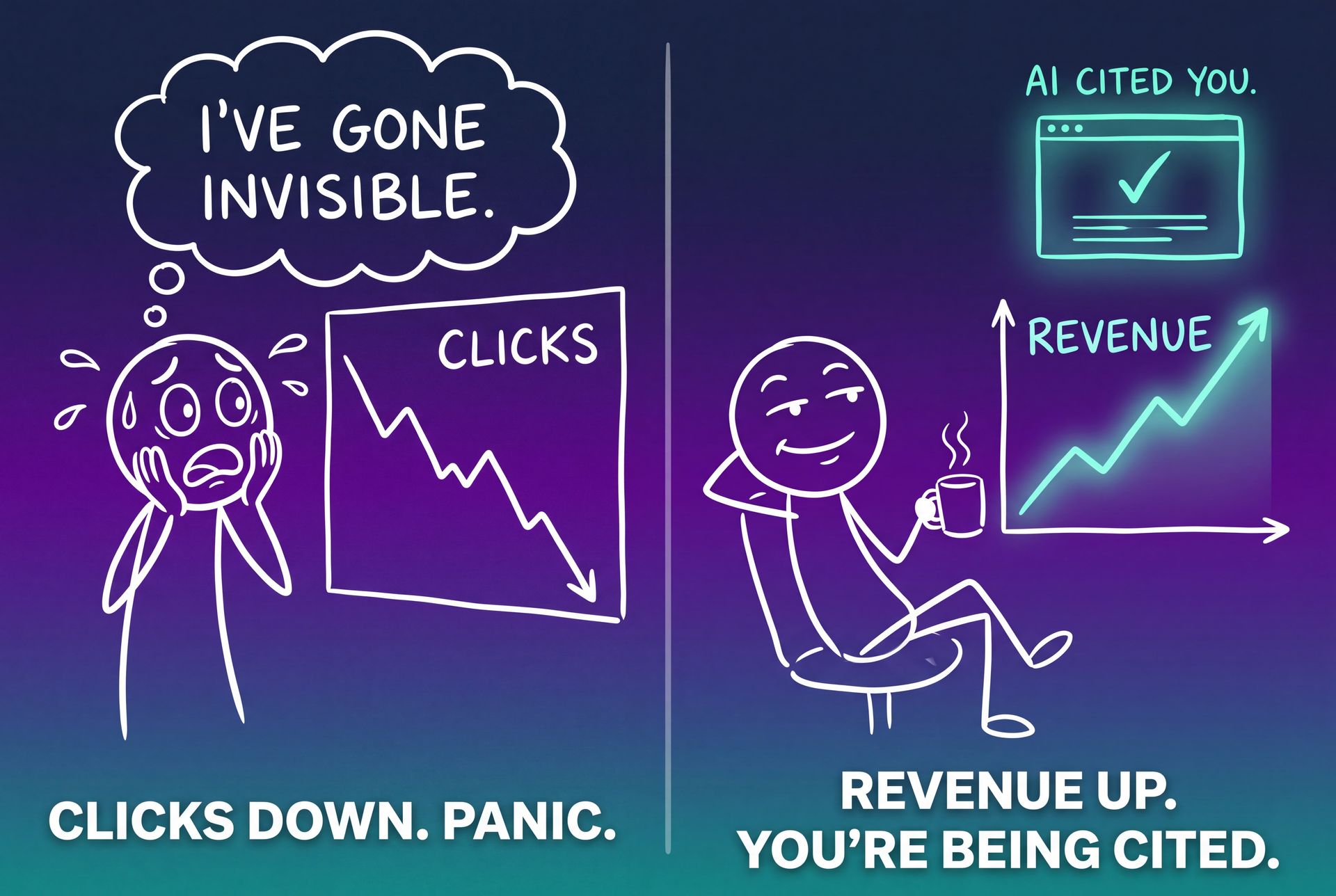
None of these are technical fixes. They are entity and trust signals, which is what AI search actually weighs in 2026. Fix the foundation, then hire.
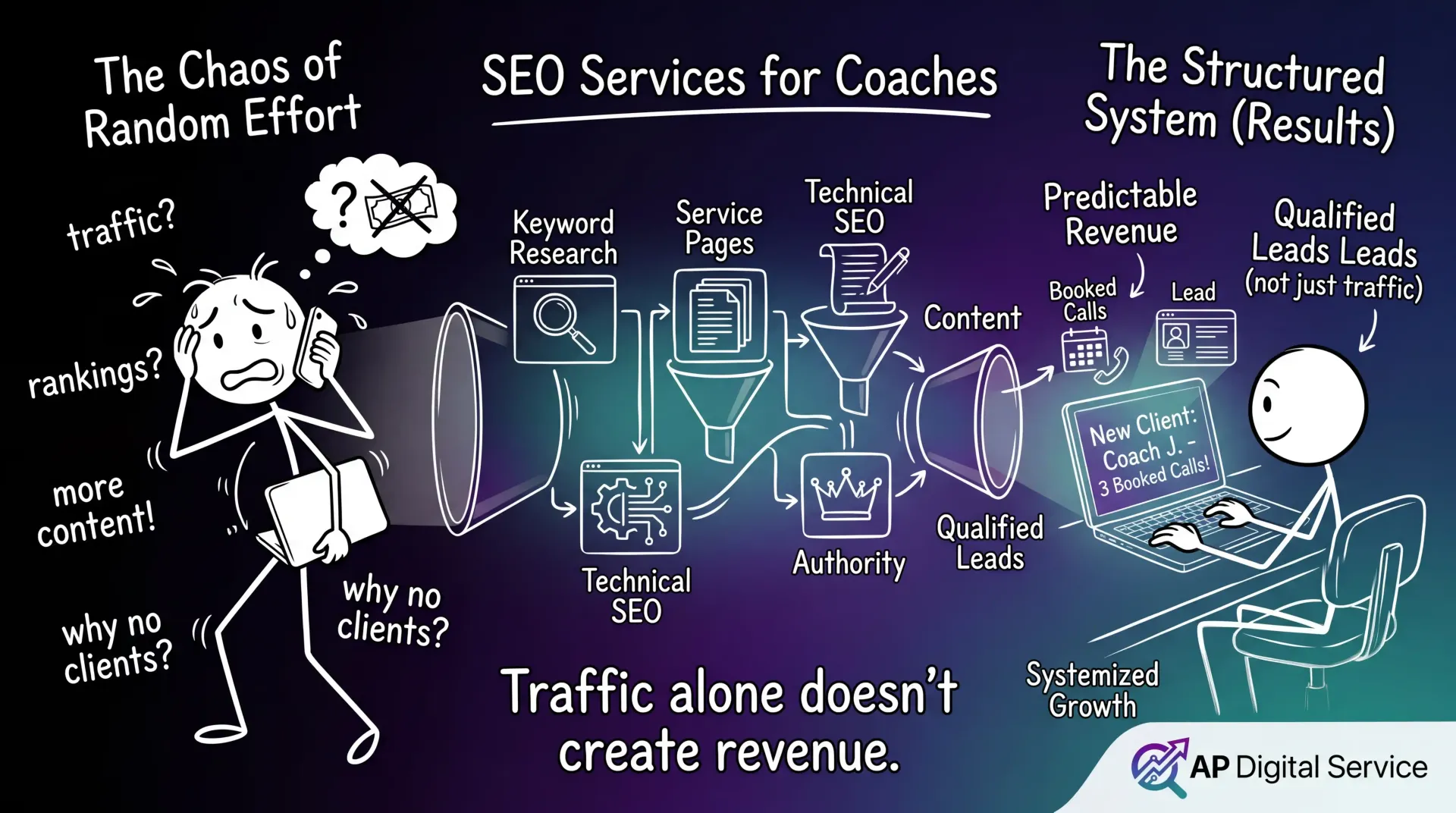
Most coaching website audit lists are technical. Submit your sitemap. Compress your images. Fix your meta descriptions. All real, all worth doing, none of it is going to save a coaching business in 2026.
The actual reason most coaches are invisible has nothing to do with whether their H1 tag is configured correctly. It has to do with whether anyone, human or AI, can tell who they are, what they do, who they serve, and whether they are still in business.
That is the list below. Twelve items to fix before you hire an SEO agency. They are not technical. They are foundational. If you skip these, the technical work will not save you, because the agency will be optimizing a business that Google and ChatGPT cannot identify clearly enough to recommend.
We run a version of this list as part of our Visibility Reviews, which is our diagnostic for established coaches who want to know why their site is not pulling its weight in both Google and AI search. The 12 items below are the ones we see most often, in the order that matters most. You can work through them yourself.

1. Claim your Google Business Profile
This is the cheapest, fastest credibility signal available to a coaching business in 2026, and most coaches still do not have one.
Google Business Profile (formerly Google My Business) is the entry that shows up on the right side of search results when someone searches your name. It is also one of the first sources Google trusts when it tries to figure out whether a business is real. ChatGPT, Perplexity, and Claude all pull from this same data when deciding whether to mention a business in AI search.
If you do not have a profile claimed, your business does not exist as a verified entity in Google's eyes. You can be a real business with real revenue and real clients, and Google still treats you like a rumor.
Claim it (it is free, takes 15 minutes), verify it, fill out every field, add real photos, and keep your hours and contact info accurate. For service-area businesses with no physical office (which most coaches are), you can hide your address but still get verified.
Do not skip this because you work from home. Especially do it then.
2. If you have multiple sites for the same business, kill all but one
This is the most common entity-confusion issue we see with established coaches, and it is silently destroying their authority.
The pattern goes like this.
The coach started with one site.
Then they launched a course and built a separate site for it.
Then they rebranded part of their business and built another site.
Then someone told them to build a landing page on a different domain for ads.
Now there are four sites, each with some version of the same business information, none of them owning the full authority.
Google and AI tools work on entity recognition.
They are trying to figure out which website is the canonical source for "Jane Smith, executive coach." When four different domains all claim partial ownership of that entity, the system has to guess.
Usually it guesses wrong, or it splits the authority across all four, which leaves none of them strong enough to rank.
Pick the one. Move everything to that domain. 301 redirect the others permanently. Yes, you will lose some short-term traffic. You will gain long-term authority.
This single move has taken coaching sites to page one.

3. Do not duplicate your content across platforms
If you write a blog post and publish the exact same content on your website, LinkedIn, Medium, and Substack on the same day, you are competing with yourself for the same query, and you are signaling to Google that none of those versions is the original.
This is not the old Google duplicate content penalty (which barely exists anymore). It is worse. AI tools are now trying to identify which source originated a piece of content, and they cite the original.
When you copy-paste across four platforms simultaneously, the algorithm cannot tell which one is yours. Sometimes it picks Substack. Sometimes it picks Medium.
Almost never does it pick your website.
The fix is to write content for each platform natively. The blog post lives on your site. The LinkedIn post is its own thing, with its own hook, written for LinkedIn.
The Substack version is a different angle on the same idea. Same expertise, different surface.
This is more work, and it is the difference between content that compounds and content that just exists.
4. Your website should be the first place your blog content lives
Related to item three, and important enough to be its own thing.
If you publish to Substack first and then post the same content on your website a week later, Substack is the original source.
Google indexes Substack first.
ChatGPT cites Substack.
Your website becomes a copy of someone else's platform.
This is happening to coaches every day because the email list lives on Substack or Beehiiv or Kit, and the content goes there first. The website gets the leftover version, two weeks late, and never gets credit.
Flip the order. Publish to your website first. Wait 48 to 72 hours. Then post the same content (or a different angle on it) to Substack with a clear link back to the original on your site. Any platform you publish on should have a canonical link pointing to your website as the source. Your website is the home base.
Everything else is a satellite. If you flip that relationship, you are renting authority on someone else's domain forever.

5. If you have a business social account you do not post to, delete it
An abandoned Instagram or X or Facebook page is a trust signal in the wrong direction.
When a potential client (or an AI tool) checks your business and finds a Facebook page that was last updated in 2022, they get the same impression: this business may not be active.
This is doubly true for AI search. Tools like Perplexity will check multiple sources before recommending a business, and a half-dead social presence is a strike against your active-entity status. Better to have no presence on a platform than a graveyard.
Pick the platforms you will actually post on (more on that in item 9). Delete or fully archive the rest. If you cannot delete (some platforms make it hard), at minimum pin a post that points people to where you actually are, and remove the link from your website footer.
Stop directing anyone to a dead account.
6. Get clear on the one person your business serves
This is the item most coaches do not want to hear because it feels limiting. It is not limiting. It is the entire reason your site is not ranking.
If your website tries to serve beginner coaches, mid-career professionals, and senior executives, your topical authority is split three ways.
Google cannot decide what you are an authority on.
ChatGPT does not know which audience to recommend you to.
The coach who only serves senior executives in healthcare will beat you on every healthcare-executive search, even if you have more experience overall.
Search engines and AI tools reward specialists.
They cite specialists.
They recommend specialists.
They have to, because users want specific answers to specific problems, not general answers from generalists.
This is also why your messaging probably feels off when you read it. Generalist coaching language reads as vague to humans too. "I help leaders unlock their potential" describes nobody specific. "I help VPs and Directors in hospital systems lead through clinical staff shortages" describes one person, and that person knows immediately whether you are for them.
Pick the one. Build the site around that one. You can always serve other people once your authority is established, but you will not establish authority by trying to be three things at once.
7. Ask clients for Google reviews, with named permission
Google reviews on your Google Business Profile (item 1) are the strongest E-E-A-T signal a service business can collect.
They are verifiable, they are time-stamped, they are public, and they come from real accounts that Google has at least loosely verified.
The trick is asking.
Most coaches do not ask their clients for Google reviews because it feels awkward.
It is more awkward to have a six-figure coaching business with two reviews on Google.
Build a simple ask into your client offboarding: "If you got value from this work, would you leave a Google review? Here is the link." Send the link. Make it one click. Do not ask for a five-star review. Ask for an honest one. Most people who finish a coaching engagement and felt it worked will leave a real review if you make it easy.
Then ask for permission to use their name and (ideally) their photo on your website. Anonymous testimonials are weak. Named testimonials with a photo and a title ("Sarah K, VP of Operations, [Hospital System]") are dramatically stronger.
If they cannot share publicly because of their employer (very common in executive coaching), ask if you can use first name and industry. Something is always better than nothing, and nothing is always better than fake.
8. Start PR outreach now, even if you do not feel ready
The fastest way to get cited by AI tools is to be mentioned on websites AI tools already trust.
Podcasts, guest articles on niche industry publications, contributor pieces on places like Forbes councils (if you can swing it, one of our clients did!), interviews on industry blogs. Not press releases. Real third-party content.
This is a long game. A guest podcast you record this month will start producing visibility benefits in three to six months and will still be paying off in two years. Most coaches wait until they "have a book to promote" to start outreach.
By then it is too late to compound.
Start small. Make a list of 10 podcasts your ideal client actually listens to. Pitch them. Make a list of five publications your industry reads. Pitch contributor pieces. Use HARO or its replacements (Help A B2B Writer, Featured.com, Qwoted.com) to get quoted in articles. Each one is a backlink, a citation, a piece of off-site content that says "this person is real and known in this space."
The coaches getting cited in AI search results today started this work two years ago. The coaches who will be cited in 2028 are starting now.

9. Pick one or two channels and post consistently. Cut the rest from your plan.
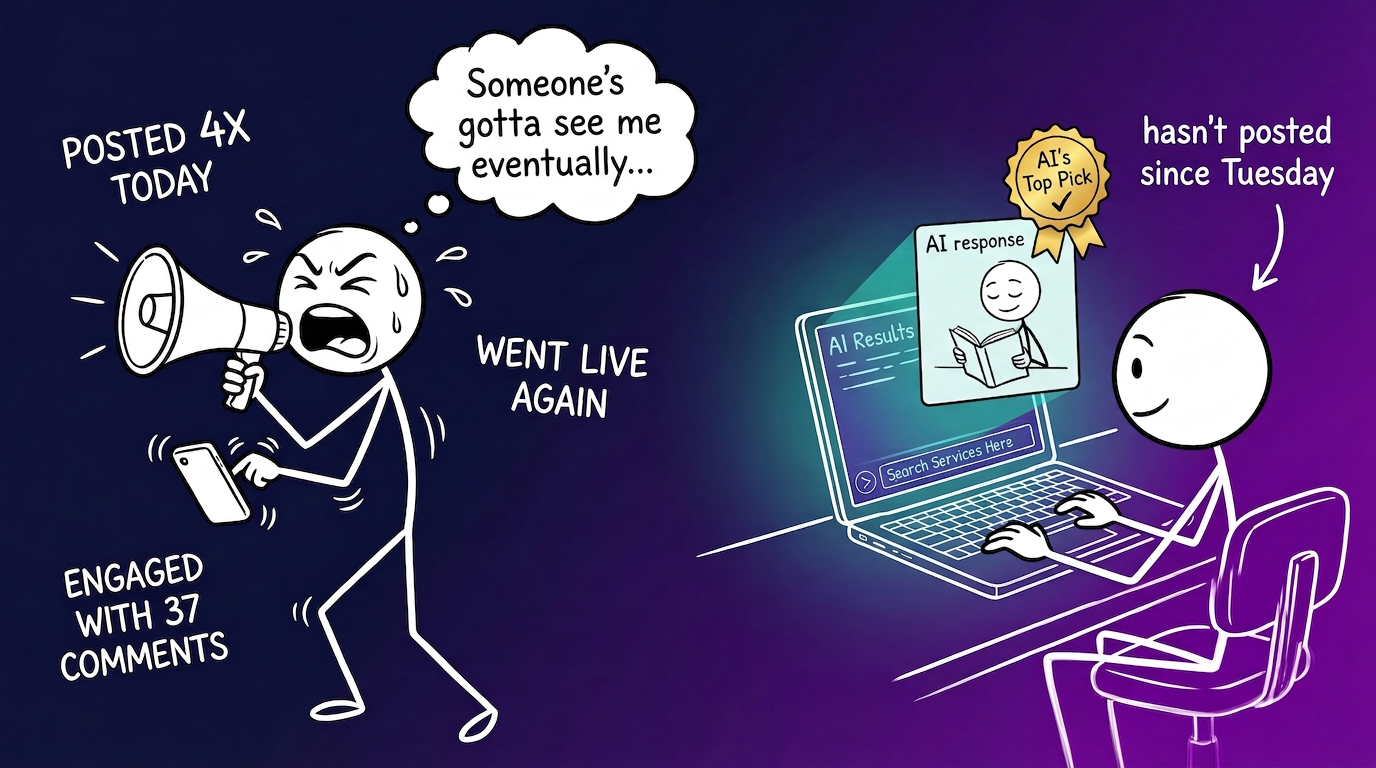
Posting once a month on five platforms is worse than posting twice a week on one. Algorithm-wise, identity-wise, and from your own sanity perspective.
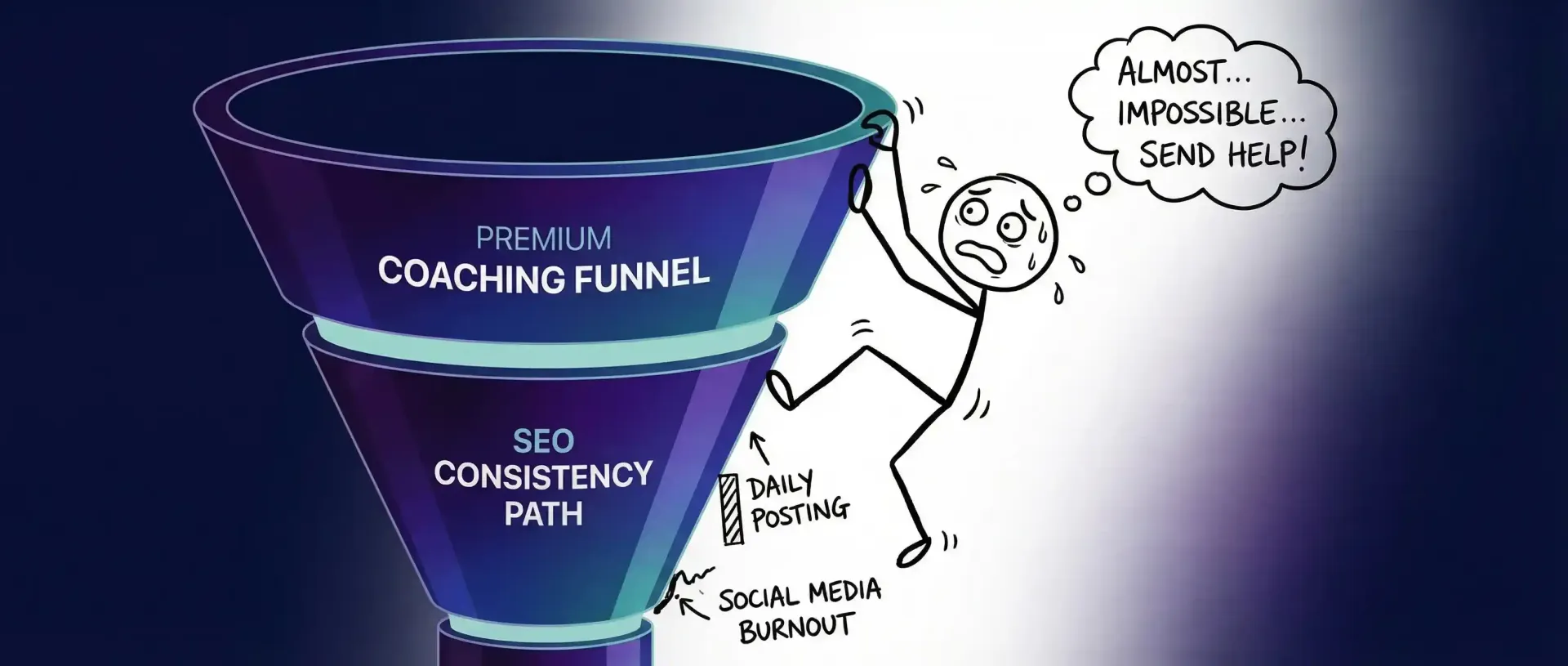
Every platform rewards consistency. LinkedIn punishes accounts that disappear for three weeks and reappear with one post. Instagram does the same. So does YouTube. The algorithm reads inconsistency as a signal that you might not be a serious account, and it down-weights your reach accordingly. Consistency is not just discipline. It is signal.
Pick the platform where your ideal client actually spends time (usually LinkedIn for B2B coaches, sometimes Instagram for lifestyle and personal development niches, sometimes YouTube for educational positioning). Pick one secondary platform if you have the capacity. That is two. Post on those two consistently for 12 months. Ignore everything else.
If you currently have a content plan that includes Threads, TikTok, X, Pinterest, Instagram, LinkedIn, YouTube, Substack, and a podcast, you do not have a content plan. You have a content fantasy. Cut six things off the list and watch the remaining two start to work.
10. Schedule quarterly photoshoots of you and your team
A current photo of you on your website is one of the most underrated trust signals there is. Both humans and AI vision models can detect when a photo is dated, and an outdated photo creates subtle distrust.
If the headshot on your About page is from 2019 and your most recent Instagram post shows that you have changed your hair, gained 20 pounds, lost 20 pounds, started wearing glasses, or aged five years, your website does not match the person who shows up on the discovery call. That gap matters more than most coaches realize.
Quarterly is the sweet spot. Every 90 days, do a shoot. New headshots, new working shots, new candid shots, new shots with your team if you have one. Refresh the website with the most recent batch. The shoot does not have to be expensive (a good local photographer or even a friend with a real camera will do). It has to be current.
For coaches with team members (including assistants, associate coaches, ops people), include them in at least one shoot a year. Showing a real team on your About page is a credibility signal that solo-coach sites cannot match. If you have one person helping you part-time, put them on the team page.
Your website should reflect that you are a real operation, not one person and a Squarespace template.
11. Make your offer description crystal clear in one sentence
If you cannot describe what your main offer is in a single sentence, neither can Google, neither can ChatGPT, and neither can your potential client.
This is the schema problem and the human problem at the same time. AI tools that try to summarize your service will produce a clear sentence describing it, or they will skip you in favor of a coach whose offer is easier to summarize. Human visitors who land on your sales page will spend roughly six seconds trying to figure out what you sell, and if those six seconds do not resolve into clarity, they leave.
The sentence should answer: what is it, who is it for, what is the format, what is the outcome. Example: "A six-month 1:1 executive coaching engagement for healthcare VPs leading through clinical staff shortages, with biweekly sessions and unlimited Voxer access between calls." That is one sentence and you know everything you need to know.
Compare that to: "A transformational coaching journey designed to help you step into your next-level leadership and unlock your highest potential." That is also one sentence and you know nothing.
Write the clear version. Put it at the top of your offer page. Put it in your meta description. Put it in your bio. Use the exact same sentence everywhere. Repetition of the precise description is what builds the entity signal that lets you get cited in AI search for the specific thing you actually do.

12. Get video testimonials and put them on YouTube
YouTube is the second-largest search engine in the world and it is owned by Google. Video testimonials on a YouTube channel attached to your business do three things at once: they build social proof, they create searchable content under your brand, and they generate citable assets that AI tools can reference.
Most coaches collect written testimonials and stop there. Written is fine. Video is better, by a wide margin. A 90-second video of a real client describing what changed for them after working with you is harder to fake, more emotionally credible, and indexable in a way that text alone is not.
The ask is the same as item 7. After a successful engagement, ask. "Would you be willing to record a short video about your experience? I'll send you three questions, you can answer them on Zoom or your phone, and it'll take less than 15 minutes of your time." Most clients who got value will say yes if you make it easy.
Set up a YouTube channel under your business name. Upload the testimonials. Use real titles like "How [Client Name] Doubled Her Team's Performance After Working With [Your Name]." Write proper descriptions. Use chapter markers if the video is over two minutes. Link to each video from the case study or testimonial section of your website. Build it slowly. Even three video testimonials is more than 95 percent of coaching businesses have.

What to do with this list
The first time you read through these 12 items, you may notice that none of them are about your website's code. That is the point. By 2026, the visibility battle for coaches is being fought on entity clarity, trust signals, and being the obvious citable source for a specific question. Technical SEO matters, but it is downstream of all of this.
If you are looking at this list and counting how many items you have nailed: anything under six and the SEO agency you are about to hire will not be able to do their job to the best of their ability. Instead, they will first work to clean all of these things up. Get the foundation right first, then hire.
If you want help working through these in order, with the AI visibility layer mapped on top, that is what our Visibility Reviews are for. We do them for established coaches running six and seven-figure offers, and we tell you exactly what is broken and what to fix first. No padded list of 47 items. Just the diagnosis you need before you spend money on the rest of it.
Or work through it yourself. The list is the list either way.Site Theme.