
Peter Ramacher • May 7, 2026
How SEO And AI Visibility Work Together In 2026 For Established Coaches
TL;DR
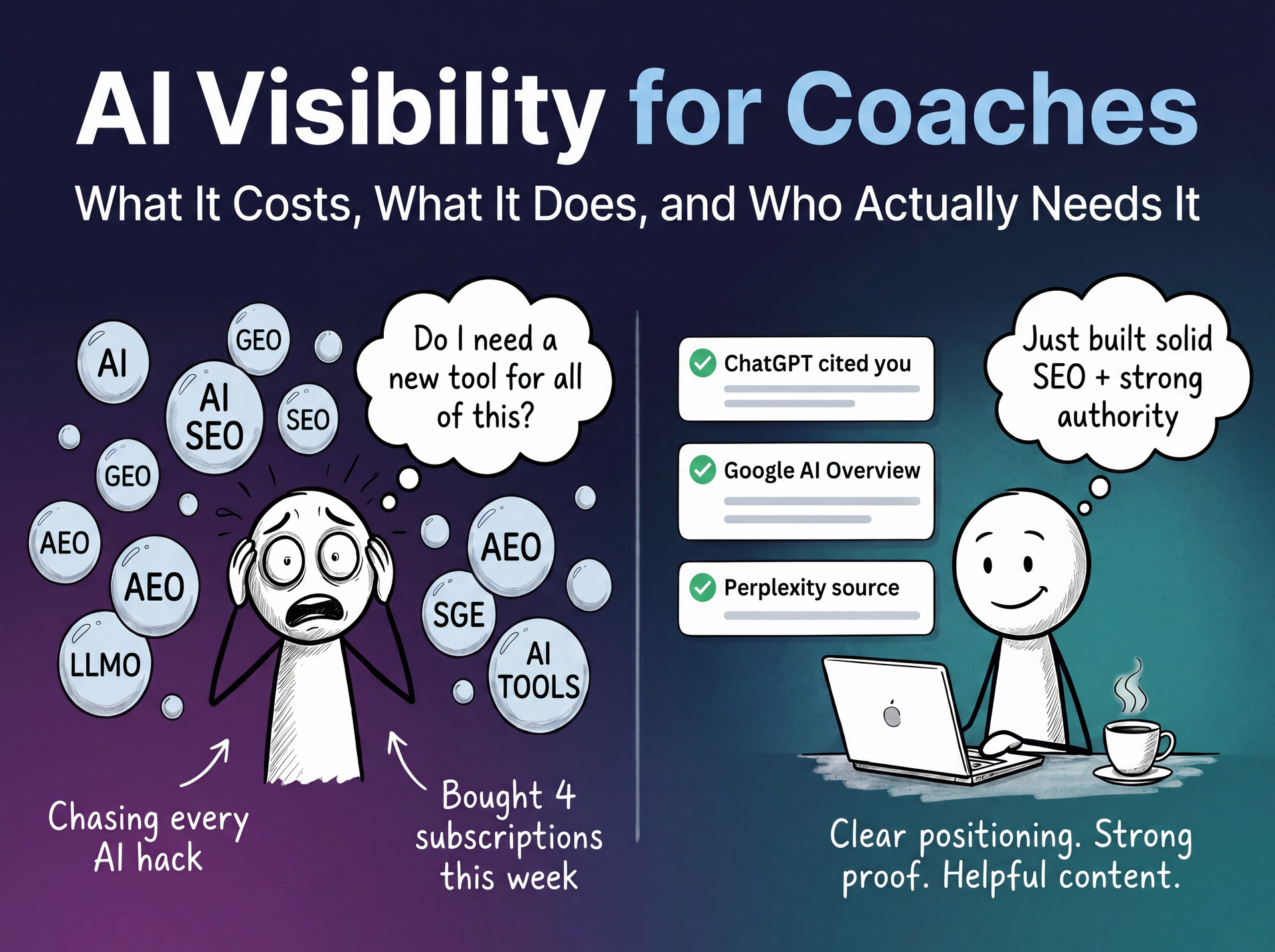
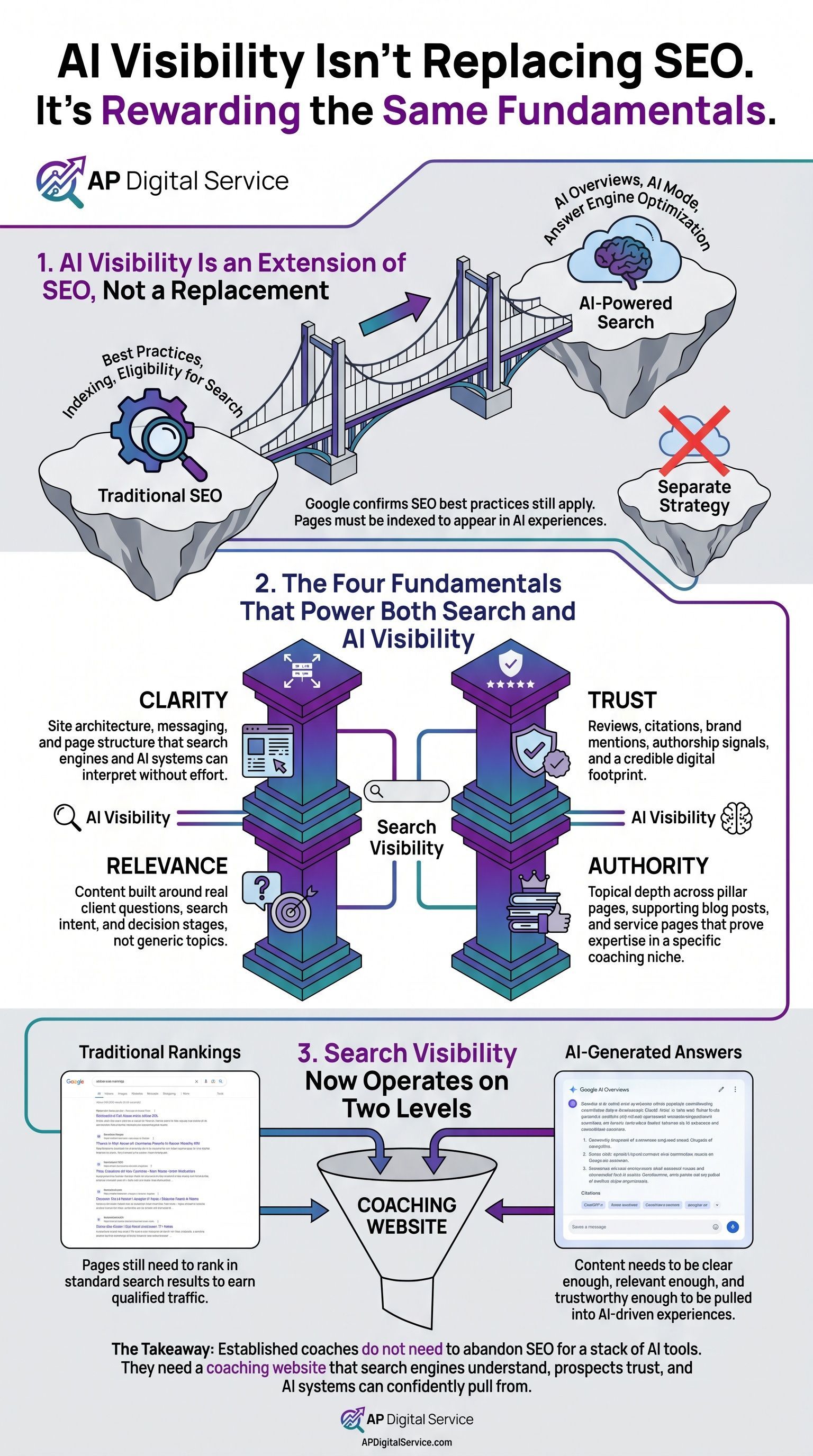
- AI visibility is not replacing SEO. It rewards the same fundamentals: clarity, trust, relevance, and authority.
- Established coaches need both traditional search visibility and AI visibility, which means building content and website structure that search engines and AI systems can understand.
- Search intent matters more than ever. In 2026, winning content is built around real client questions, decision stages, and trust-building — not just keywords.
- Authority is built across your whole digital presence, including blog content, service pages, internal linking, technical SEO, reviews, citations, and even unlinked brand mentions.
- AI can help with research and efficiency, but it cannot replace lived experience, original insights, or the credibility that comes from real expertise and case studies.
- The goal is not to chase hacks. It is to build a coaching website that earns visibility in both search results and AI-generated answers — and converts that visibility into qualified opportunities.
Introduction
If you’re an established coach with a proven offer, the real question in 2026 is not whether to focus on SEO or AI visibility.
It’s whether your coaching business has built enough authority, clarity, and trust for both search engines and AI systems to understand, surface, and recommend you.
That distinction matters.
A lot of coaches are hearing mixed messages right now. Some are being told that traditional SEO is fading because AI powered search is taking over. Others are being told to chase answer engine optimization, generative engine optimization, or specialized tools as if AI search requires a completely separate digital strategy.
But that is not what the evidence shows.
Google says the same SEO best practices still apply for AI features like Google’s AI Overviews and AI Mode, and that pages need to be indexed and eligible for Google Search in order to appear as supporting links in those experiences. Google also says AI Mode relies on high-quality web content, and AI Overviews provide links so people can dig deeper.
That is why the main takeaway of this post is simple:
AI visibility is not replacing SEO.
It is rewarding the same things strong SEO was always supposed to build:
- Clarity
- Trust
- Relevance
- Authority
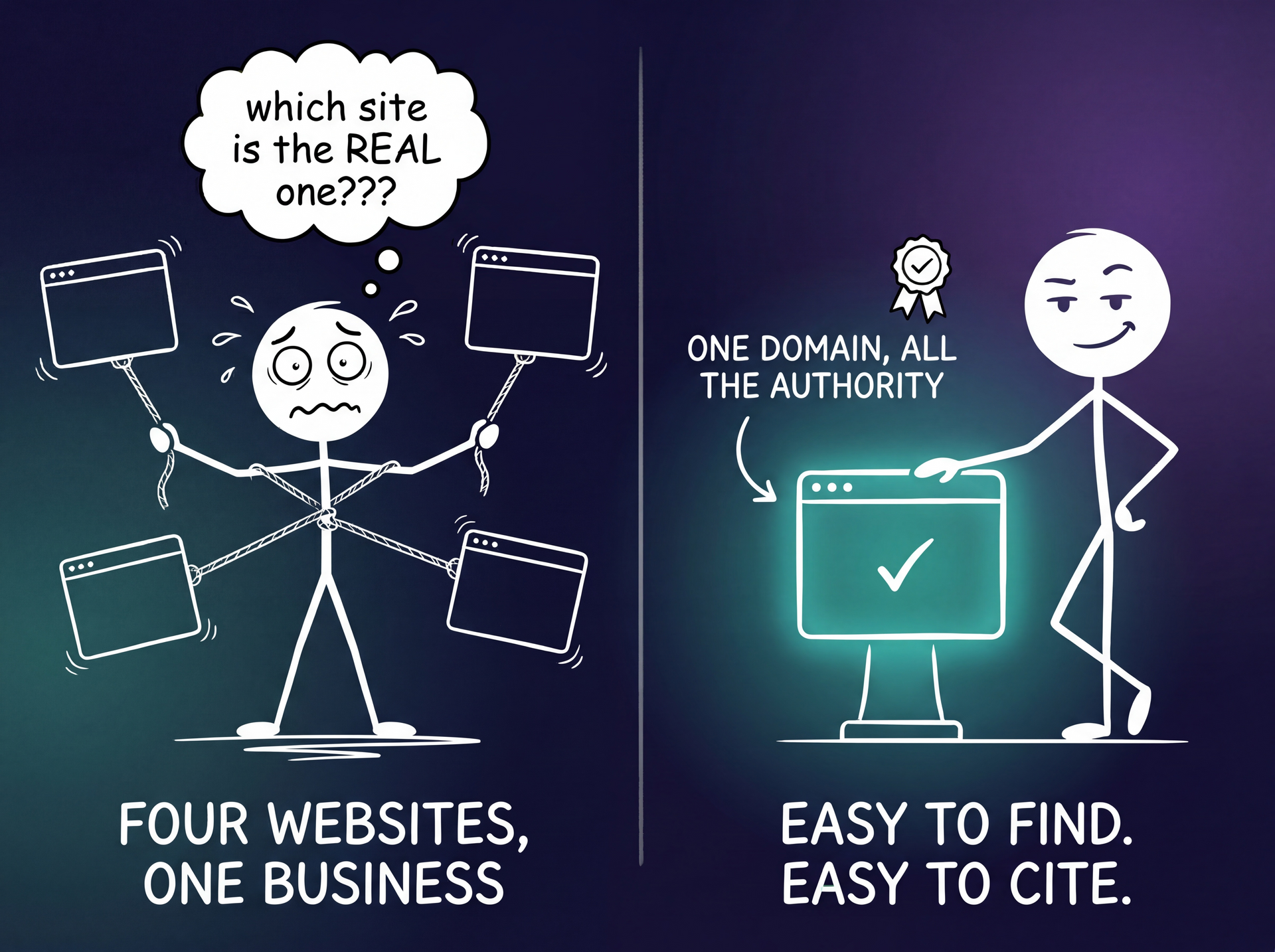
For established coaches, that is good news. It means you do not need to abandon SEO strategy for a bunch of AI tools. You need to build a coaching website that search engines understand, that prospects trust, and that AI driven search engines can confidently pull from when creating AI generated answers.
What is changing in 2026 is the scope of optimization. SEO strategies now need to account for visibility across AI-powered search experiences as well as traditional rankings, which means authority, clarity, and interpretability matter across more surfaces than before.
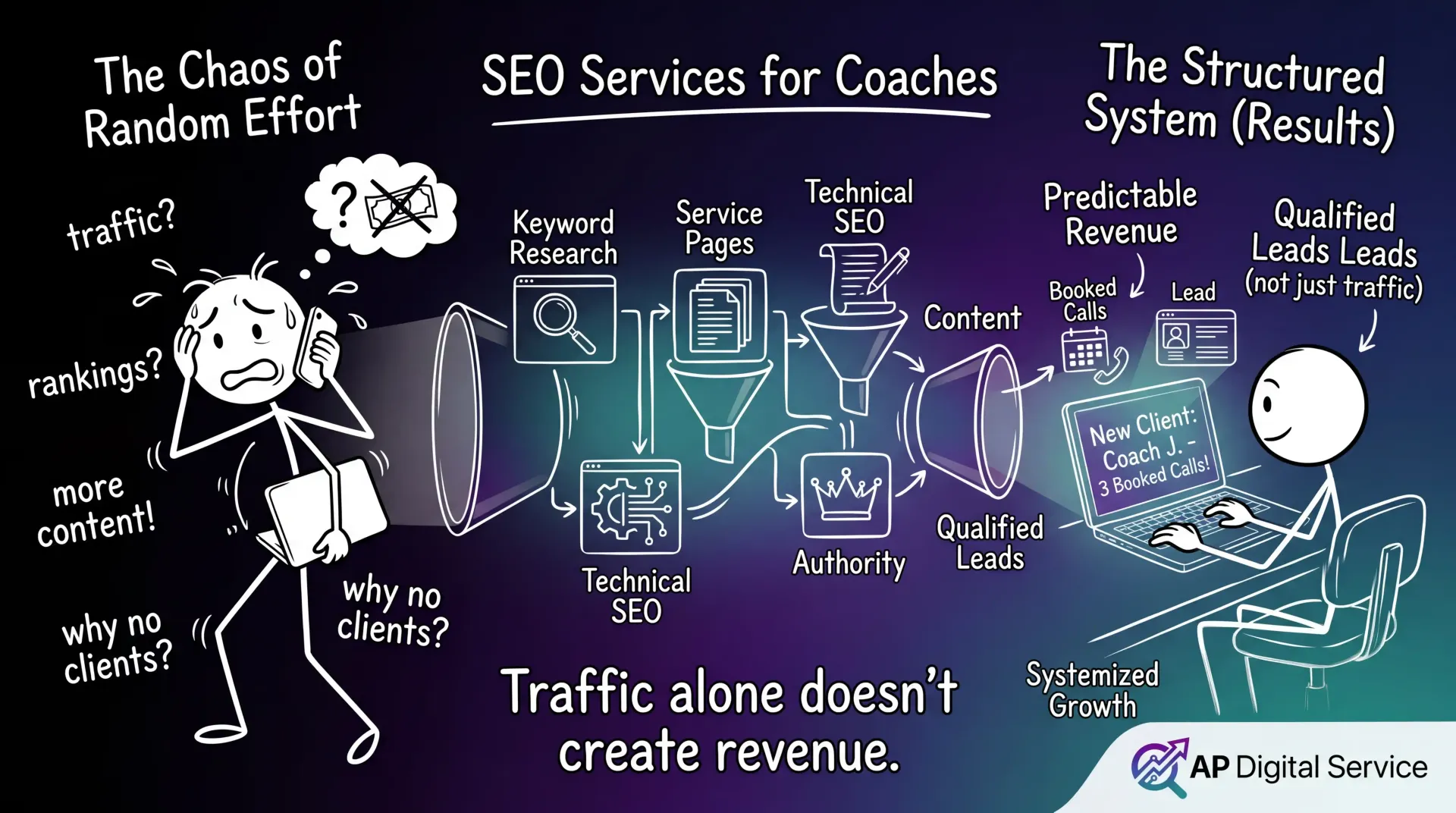
This is exactly why we use our Full-Funnel Search System™ at AP Digital Service. Rather than treating SEO, AI visibility, and conversion as separate goals, we build them to work together so established coaches can increase discoverability at the top of the funnel, strengthen trust in the middle, and convert more qualified buyers at the bottom.
Transforming SEO: The New Visibility Landscape For An Established Coaching Business
The old model of search was dominated by ten blue links in the search results. That model is not gone, but it is no longer the full picture.
Now, search results can include AI Overviews, AI answers, featured summaries, conversational follow-up prompts, and citations pulled into AI assistants and AI platforms.
Search behavior is changing because users are asking more layered questions and expecting faster synthesis. Google has publicly said that with AI Overviews and AI Mode, people are asking more complex questions and engaging with Search in new ways.
For a coaching business, that means search visibility now operates on two levels:
- First, you still need to rank pages in traditional search results and earn qualified traffic through solid SEO fundamentals.
- Second, your content now also needs to be clear enough, relevant enough, and trustworthy enough to be pulled into AI-generated answers and AI overviews.
At AP Digital Service, we have seen that this shift does not reduce the value of SEO. It increases the value of doing SEO correctly. Our experience has been that AI visibility tends to follow strong SEO infrastructure, especially when site architecture, internal linking, topical relevance, and trust signals are aligned.
That matters for personal brands, life coach offers, business coach offers, and premium coaching businesses alike. If your authority is buried in scattered blog posts, vague landing pages, weak meta descriptions, broken links, or inconsistent messaging, both search engines and AI systems have a harder time understanding what you do and why you are credible.
How Search Engines And AI SEO Evaluate Coaching Content
When people talk about AI SEO, they often make it sound like something entirely separate from regular SEO.
It is not.
Google’s own documentation says there are no special optimizations needed beyond the standard practices that already support visibility in Search. Helpful, reliable, people-first content still matters. Technical SEO still matters. Crawlability, indexing, relevance, and page eligibility still matter.
In practice, that means search engines understand your coaching website through signals like:
- Clear topical relevance
- Useful page structure
- Strong on page SEO
- Structured data for key content types such as articles, FAQs, reviews, and services
- Internal linking
- Consistent entity signals
- Trustworthy authorship and human expertise
- Site speed and clean technical SEO fundamentals
It also means AI systems are more likely to surface content that is easy to interpret, directly answers questions, and demonstrates authority instead of merely echoing generic digital marketing advice. Google’s guidance on people-first content emphasizes original value, expertise, and satisfying user needs, while its guidance on generative AI says using generative AI at scale without adding value can violate spam policies.
In practice, that also means AI models are likely to favor content that reflects Experience, Expertise, Authoritativeness, and Trustworthiness. For coaches, that raises the value of real client stories, firsthand observations, original frameworks, and case studies. AI can summarize facts, but it cannot replicate lived experience, which is exactly why experience-backed content matters more now, not less.
So for coaches, the opportunity is not to create content faster just because artificial intelligence can help draft it.
The opportunity is to create content better.
Search Intent Still Determines Whether You Get Qualified Traffic
One of the easiest mistakes in transforming SEO for a coaching industry website is chasing relevant keywords that look attractive in keyword research but do not match real buyer intent.
Search intent is still the filter that separates vanity traffic from business outcomes.
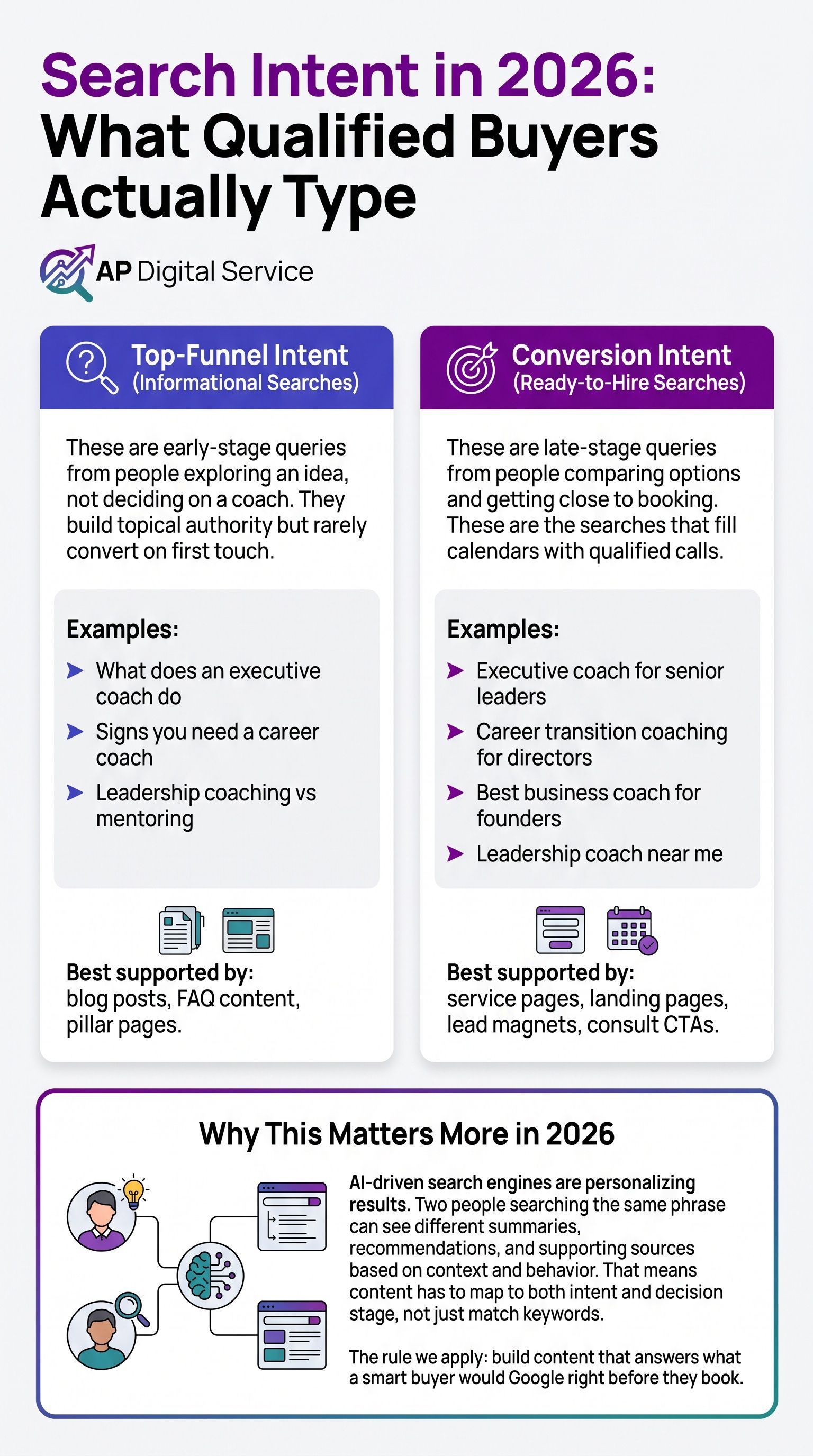
Top-funnel intent might sound like:
- What does an executive coach do
- Signs you need a career coach
- Leadership coaching vs mentoring
Conversion intent sounds more like:
- Executive coach for senior leaders
- Career transition coaching for directors
- Best business coach for founders
- Leadership coach near me
Those are different searches with different expectations.
That distinction matters even more now because AI-driven search engines are increasingly personalizing results. Two people can search the same phrase and see different recommendations, summaries, and supporting sources based on context, behavior, and profile signals. That is one reason content optimization in 2026 has to prioritize search intent and decision stage, not just keyword matching.
Established coaches need content strategy and landing pages that map to both. Blog posts can help rank pages for informational questions and build topical authority. Service pages, opt in forms, and conversion-focused landing pages can capture people who are closer to action.
This is exactly what we have seen over the years. We have found that consistently publishing authoritative, expertise-driven blog posts that answer real questions for a specific ICP leads to page-one visibility, citations in Google AI Overview, Perplexity, and ChatGPT, and stronger visibility for key service pages. For our client, Broda Coaching, the blog posts did not just perform on their own. They helped lift the broader site, including the main service pages.
That is a crucial point for coaches who assume blog posts only matter for blog traffic.
They also support the pages that sell.
Topical Authority And Content Marketing Matter More Than More Content
A common misconception in AI search is that businesses now need more content volume to stay visible.
For established coaches, that is usually the wrong move.
The better move is clearer authority.
Google’s people-first content guidance rewards content that is genuinely useful, original, and created to help people rather than manipulate ranking factors.
This means that more content is not always more growth, and that stronger authority and trust are what actually move a coaching business forward.
In practical terms, content marketing for coaches should focus on:
- Pillar pages built around your coaching niche
- Blog posts that solve specific problems your ideal client has
- FAQs that mirror conversational search behavior
- Landing pages for service-intent searches
- Recurring updates that keep your best pages fresh and accurate
- Client stories and trust-building proof that support conversion
This is how topical authority grows.
You are not trying to flood search engines with generic pages. You are giving search engines and AI models enough high-quality context to understand your niche, your offer, your coaching business, and the real questions your audience is asking.
Blog Posts, Landing Pages, And AI Visibility Work Together
One of the strongest real-world points from our experience is that blog posts can improve more than blog performance.
After launching a new site and applying SEO plus AI SEO tactics for Broda Coaching, the website generated roughly $208,000 in annualized revenue from its first 11 months, with about half the traffic coming from organic search and the other half from LinkedIn.
We also witnessed the Better Work program of Broda Coaching achieve visibility in Google AI Overviews, including a #1 recommendation result for a broad coaching-related query in 2026, generated 149 qualified applicants, and influenced $148,205 in revenue in under 9 months.
The lesson is not just that blog posts can rank.
The lesson is that strong blog content, smart internal linking, clear site architecture, and aligned service pages can strengthen the authority of the entire domain. That helps rank pages more effectively across the site and increases the odds of being surfaced in AI-powered search and AI overviews.
This is a core principle of our Full-Funnel Search System™: content should not operate in isolation. It should support visibility, reinforce trust, and move the right prospect toward conversion.
For established coaches, this is where SEO strategy becomes more important than publishing.
It becomes infrastructure.
Meta Descriptions, On Page SEO, And Technical SEO Still Influence Search Visibility
It is easy to get distracted by new AI terminology and forget the basics.
But the basics still matter because they help search engines understand your pages in the first place.
That includes:
- Strong headlines aligned to search intent
- Clear meta descriptions that improve click-through from search results
- Logical heading structure
- Internal linking between related pages
- Clean structured data where relevant
- Mobile usability
- Site speed
- Removal of broken links
- Strong site architecture
- Streamlined landing pages with one clear action
Google’s documentation continues to emphasize crawlability, indexing, people-first content, and overall page experience. While page experience factors do not act like a single magic ranking lever, Google states they can affect how satisfying a page is to use, which aligns with what ranking systems seek to reward.
So yes, meta descriptions still matter. Technical SEO still matters. On page SEO still matters.
Not because they are trendy, but because they reduce friction for both humans and machines.
Off Page SEO, Trust Signals, And Reputation Still Shape Outcomes
Off page SEO still matters for coaches because authority is not built only on your own coaching website.
Search engines also look at the broader reputation signals surrounding your brand. In 2026, that goes beyond backlinks alone. Search engines increasingly treat brands as entities and use mentions across third-party platforms, publications, reviews, and discussions to help verify authority. Even unlinked brand mentions can strengthen perceived credibility, which is why they should be monitored and leveraged as part of a broader visibility strategy.
That can include:
- Link building from relevant publications
- Citations from reputable sites
- Testimonials and reviews
- Branded search demand
- Consistent signals across your digital footprint
- Brand mentions in discussions and publications, even when they do not include a link
For hybrid and in-person offers, local SEO can strengthen local visibility through an optimized Google Business Profile, location signals, local schema, and location-specific client reviews. This is especially relevant for a life coach, therapist-adjacent coach, or business coach serving a defined local market.
Google’s documentation on Search and local presence continues to reinforce the value of being discoverable, indexable, and clear about what your business offers.
For premium coaching businesses, all of this adds up to one thing:
Trust signals.
And trust signals matter because SEO does more than bring in organic traffic. Our internal framework shows that authority built through SEO lowers psychological resistance, increases perceived credibility, and shortens decision cycles across channels. In other words, SEO improves how buyers experience your brand, whether they arrive from Google rankings, LinkedIn, direct traffic, AI assistants, or paid advertising.
That matters even more in AI-driven search, because AI systems evaluate reputation across a broader scope than traditional website metrics alone. For established coaches, your authority is not just what your website says about you. It is also what the broader digital ecosystem confirms.
Local SEO For Coaches With In-Person Or Hybrid Delivery
Not every established coach needs local SEO to the same degree.
But if part of your offer depends on a city, region, or in-person market, local visibility should not be ignored.
That can include:
- Claiming and optimizing your Google Business Profile
- Aligning service pages with local search intent
- Adding local context to landing pages
- Earning reviews that mention your service and geography
- Maintaining accurate business information across platforms
This does not replace broader authority building. It supports it.
For some coaches, local seo will be a secondary layer. For others, especially hybrid practices or regionally known coaching brands, it can become a direct source of qualified traffic.
Measurement: Google Analytics, AI Analytics, And Business Outcomes
If you want to future proof your SEO strategy, measurement has to go beyond traffic.
Traffic alone does not tell you whether your visibility is profitable.
Established coaches should be measuring:
- Organic traffic
- Search visibility trends
- Rankings for service-intent queries
- Landing page conversion rates
- Form completion rates on opt in forms
- Assisted conversions by channel
- Lead quality
- Branded search growth
- AI inclusion observations where visible
- Revenue influence where attribution allows
Google Analytics and Google Search Console remain essential for data analysis around search queries, page performance, click-through rates, and user behavior. Google also continues to expand AI powered capabilities inside Search products, including AI-powered configuration in Search Console, which can help analyze data more efficiently.
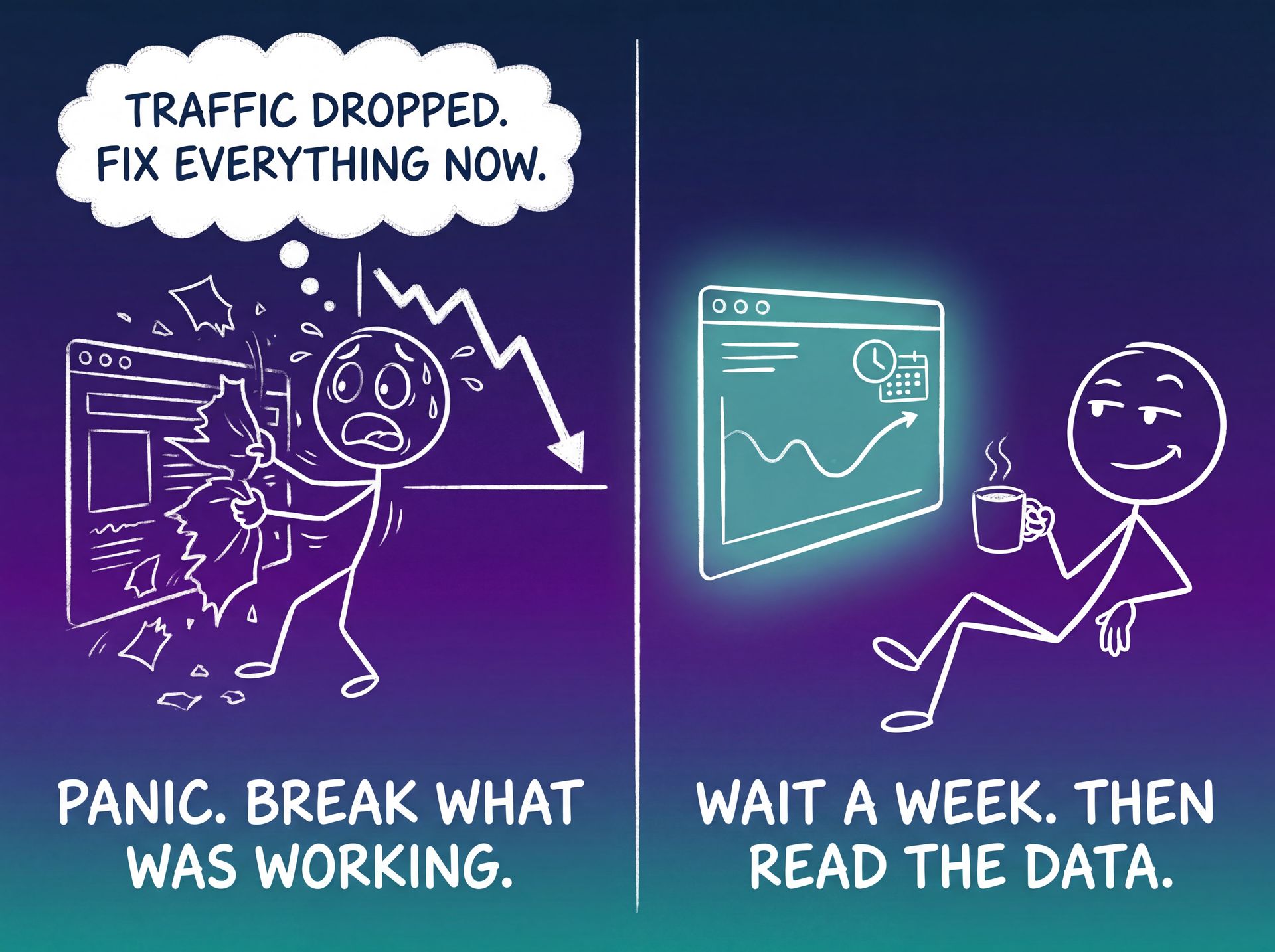
That said, predictive SEO and AI analytics should support human judgment, not replace it.
If you are using AI tools, generative AI, or other specialized tools for topic discovery and reporting, they should strengthen strategy, not make it lazier.
Operational Playbook: Using AI Tools Without Losing Human Expertise
AI tools can help with research, clustering, outlining, and workflow speed.
They can support keyword research, summarize search trends, suggest content angles, and help organize content strategy.
They can also process large volumes of search query data far faster than manual methods, which makes them especially useful for identifying patterns in search intent, content gaps, and emerging keyword opportunities.
But they are not a substitute for human expertise.
Google’s guidance is clear that using generative AI is not inherently a problem, but publishing scaled low-value content is.
For established coaches, the safest and smartest use of AI looks like this:
- Use AI tools to support topic research
- Use generative AI to draft outlines, not final authority
- Use human review to add nuance, lived experience, and conversion insight
- Use original client stories carefully and ethically
- Verify facts before publishing
- Keep confidentiality intact
- Avoid keyword stuffing and repetitive AI-written phrasing
The strongest coaching content in 2026 will not sound machine-made.
It will sound clear, experienced, and useful.
A 90-Day Direction For Established Coaches
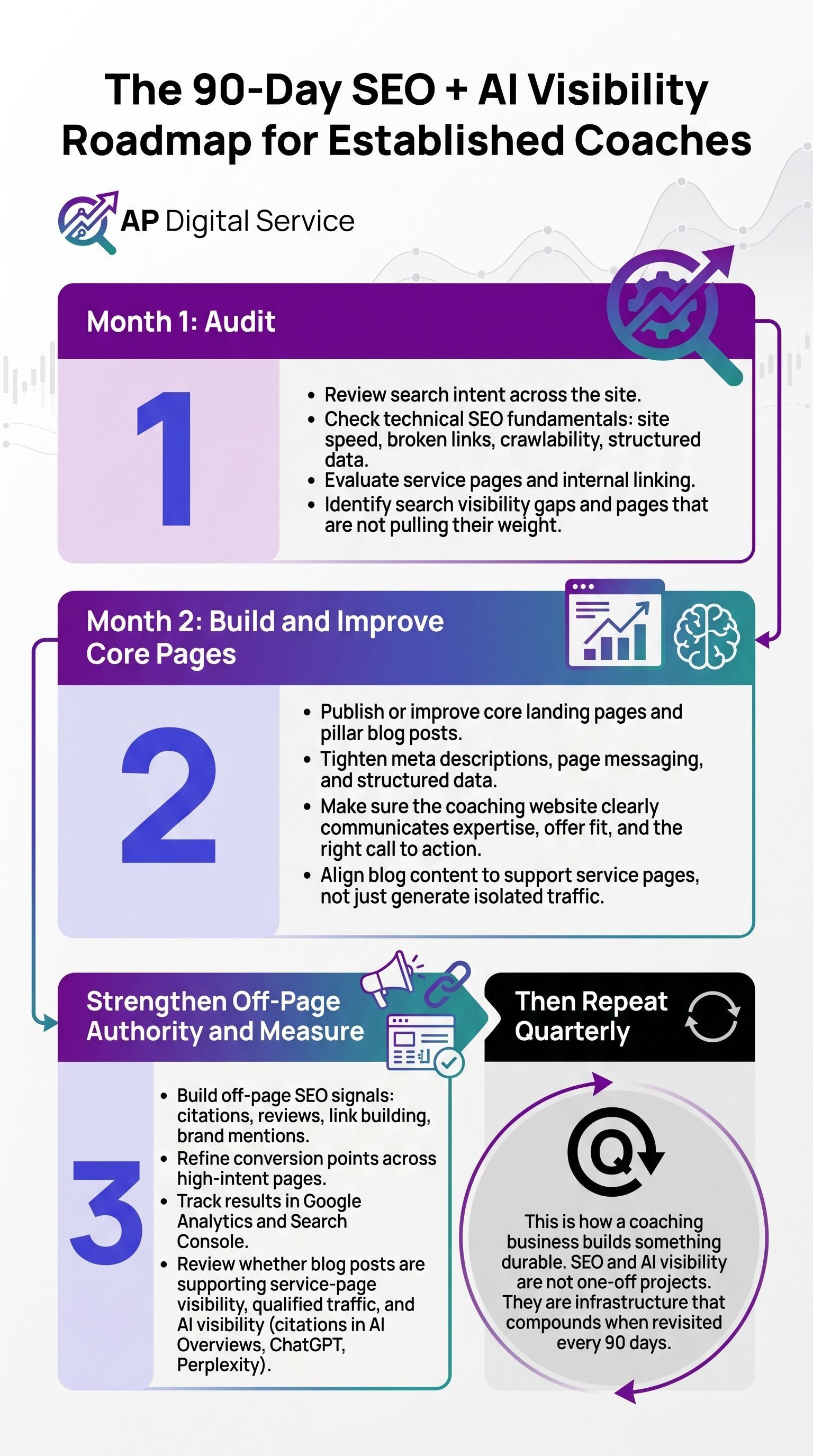
If your coaching business already has a proven offer, here is the practical roadmap.
Month 1: Audit the site. Review search intent, technical SEO, site speed, broken links, service pages, internal linking, and search visibility gaps.
Month 2: Publish or improve core landing pages and pillar blog posts. Tighten meta descriptions, structured data, and page messaging. Make sure your coaching website clearly communicates expertise and offer fit.
Month 3: Strengthen off page SEO, refine conversion points, track results in Google Analytics and Search Console, and review whether blog posts are supporting service-page visibility and qualified traffic.
Then repeat quarterly.
That is how you build something durable.
The Bottom Line On How SEO And AI Visibility Work Together In 2026 For Established Coaches
For established coaches, AI visibility is not a replacement channel sitting outside SEO.
It is an extension of search visibility that rewards the same underlying strengths: relevance, clarity, authority, trust, and technical soundness.
Google’s own documentation supports that view, and our real-world experience supports it too.
We have seen that when a coaching business routinely publishes authoritative blog posts, refreshes core website pages regularly, and optimizes technical SEO, the results can extend far beyond individual blog rankings. Those assets can contribute to citations in AI-driven experiences, stronger visibility for service pages, and better overall business outcomes.
So the goal in 2026 is not to choose between blue links on search result pages and AI answers.
It is to build and optimize the kind of coaching website that earns both.
Because the coaches who win in AI-powered search will not be the ones chasing hacks.
They will be the ones who create content people trust, structure sites search engines understand, and build authority strong enough for both search engines and AI systems to surface with confidence.
If your offer is proven but your website is not generating the visibility, trust, or qualified traffic it should, Request a Visibility Review.
We’ll look at how your site is currently performing across search, AI visibility, authority signals, and conversion opportunities so you can see where growth is being supported — and where it is being left on the table.
Sources
Google Search Central: AI Features and Your Website
Google Search Central: Creating Helpful, Reliable, People-First Content
Google Search Central: SEO Starter Guide
Google Search Essentials
Google Search Central: Structured Data Markup Supported by Google Search
Google Search Central: Debugging Drops in Google Search Traffic
Google Search Central: Get Started with Google Trends
AP Digital Service: Coaching Case Study
AP Digital Service
Google Search Central: Guidance on Using Generative AI Content

We are Peter & Amanda, the co-founders of AP Digital Service, a boutique SEO and AI visibility agency built for established coaches with proven offers. We help coaches scale through search and AI-driven discovery with < 3 hours/ month of your time.
New here? Get to know us →