Amanda Jantzen • June 7, 2026
Read time: 10 minutes
TL;DR
- The May 2026 Google core update ran May 21 to June 2. It was a normal broad update, not a penalty, and it did not target coaches.
- If your traffic dropped, wait a full week after June 2, then compare a clean week-after against the week before May 21.
- It rewards the same thing it always has: a real expert answering the question someone actually asked (E-E-A-T).
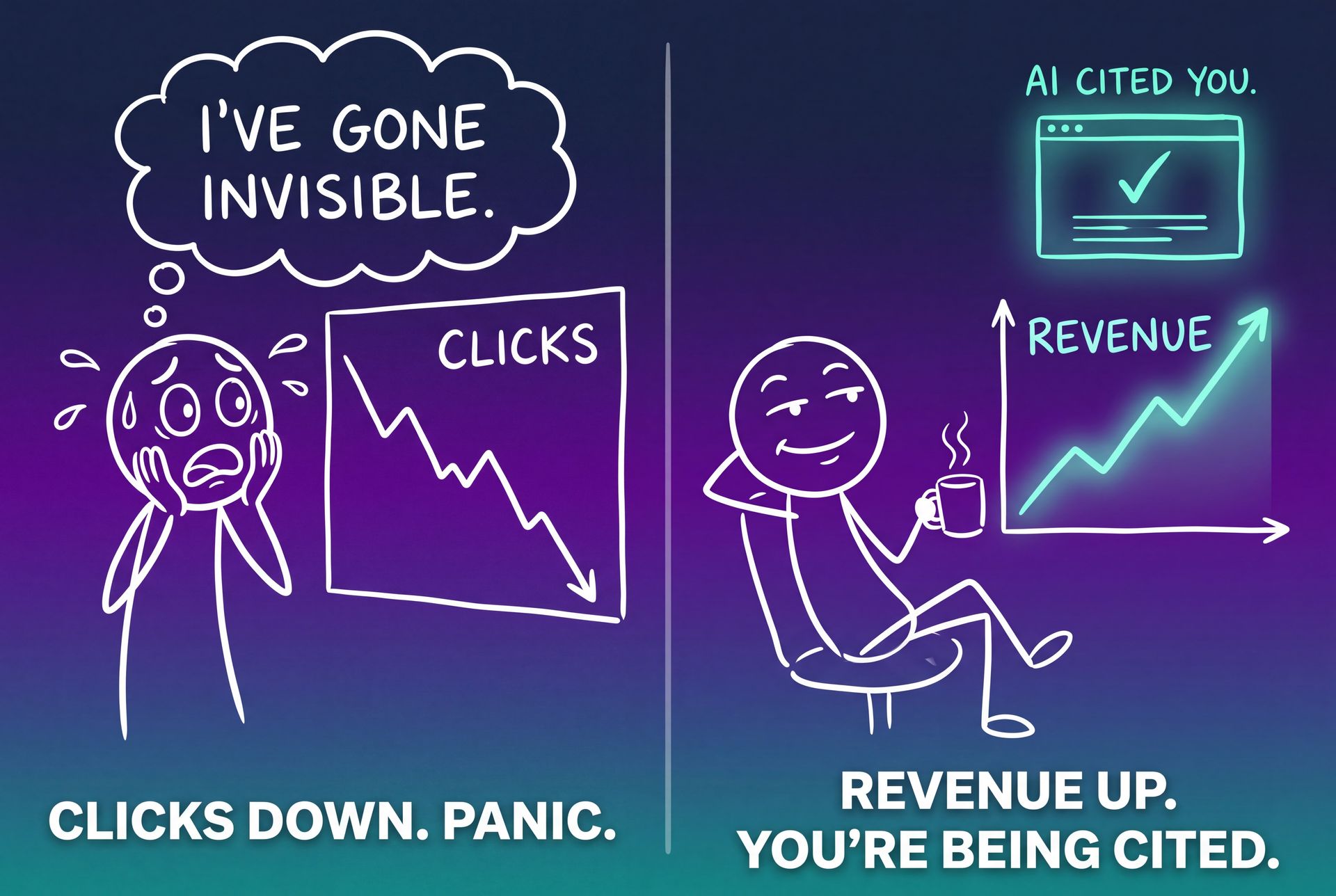
- The bigger story is AI search. People click far less when an AI answer appears, so being cited inside the answer now matters as much as ranking under it.
- The signals that get you cited by AI are the same ones this update rewarded, which is why SEO and AI visibility are one system, not two.
The May 2026 Google core update started on May 21 and finished rolling out on June 2. It was a regular broad core update, it moved rankings more than the one in March, and it did not single out coaches or anyone else
.
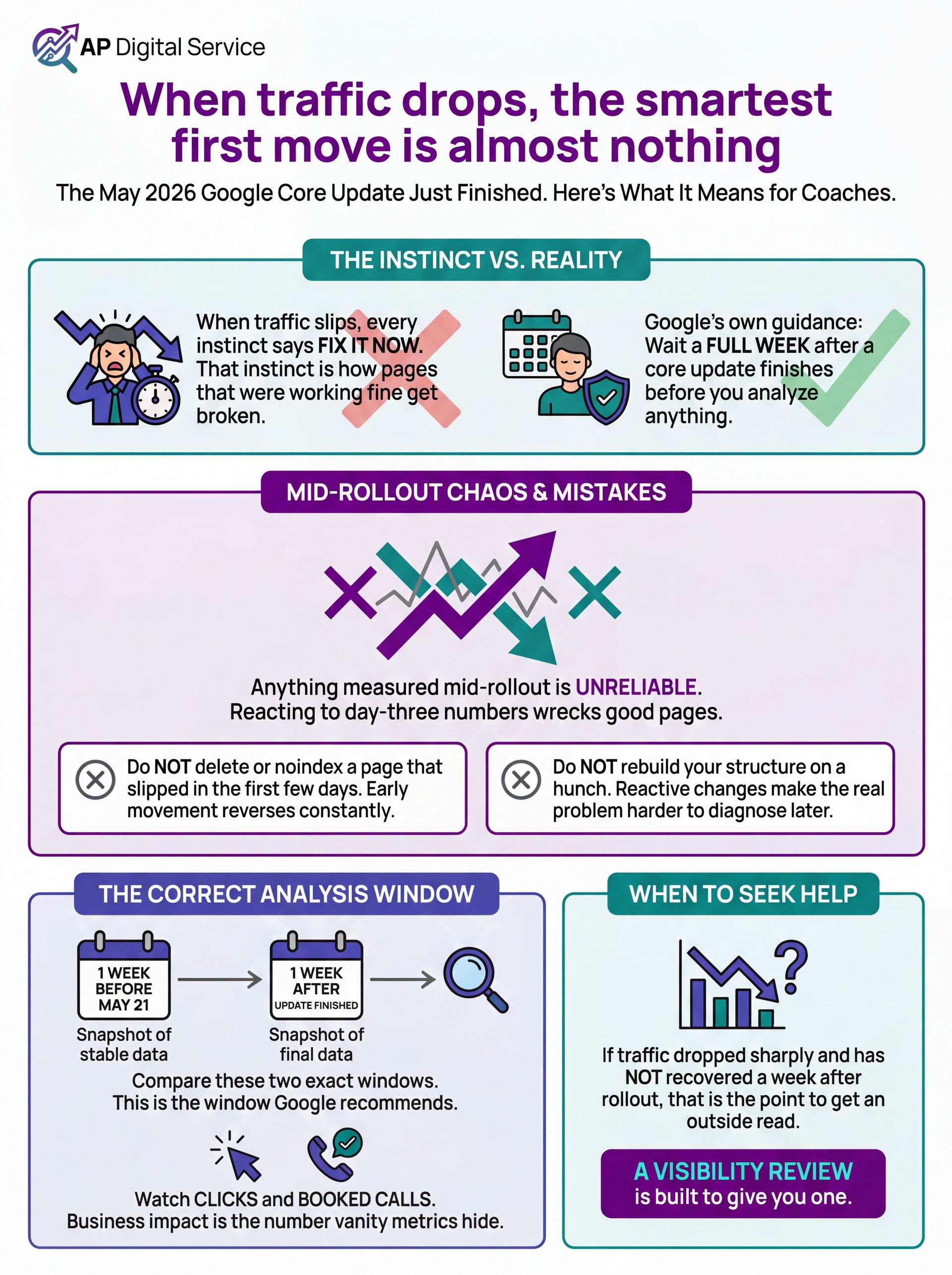
So if your traffic slipped during those twelve days, the smartest move this week is to do almost nothing.
I know that is annoying advice. When traffic drops, every instinct says fix it right now. Rewrite the page, swap the headline, push out four blog posts by Friday.
Don't.
That is usually how people break the pages that were working fine. Here is what is actually happening, and what to do once things settle down.
What is a Google core update, in plain terms?
A Google core update is Google re-grading the entire web at once. It is not a punishment, and it is not personal.
Picture a teacher who changes the grading rubric halfway through the year. Your essay did not get worse overnight. The standard it gets measured against changed. That is what happens to your pages. Google reassesses which ones best answer each search, and some move up while others move down based on the new read.
Nobody emailed you. There is no penalty box. If your rankings moved, Google did not catch you doing something wrong. It changed its mind about who answers the question best.
This was the second broad core update of 2026, and it moved rankings more than the March one. SEO practitioners across industries reported heavy swings during the rollout, and several called it more disruptive than the March core update. It also landed in the same window as Google's I/O announcements, including a new model now powering Google's AI search features, so a lot moved at the same time. If you want a sense of how your own site tends to react, the March update is your closest comparison.
A core update is also different from a spam update. Spam updates target manipulative tactics. This was a core update, so the right response is better content quality, not damage control.

What is Google's official guidance on core updates?
Google's official guidance is plain. A core update is a regular update designed to better surface relevant, satisfying content for searchers across Google's ranking systems, not a penalty aimed at any single website.
Google confirmed the May 2026 core update on the Google Search Status Dashboard, which is the same place site owners can check for ranking volatility before reacting to it.
The guidance on timing is just as clear. Wait until the rollout completes, then give it at least one more week before drawing conclusions from your post-rollout data. When you do analyze, open Search Console, set a clean date range, and compare the week after the update with the week before it started.
Google rarely says what specifically changed in a core update, so hunting for one cause is wasted effort. The better response is to raise content quality and show real expertise across the site, because that is what helps Google surface relevant, satisfying content in the first place.
Did the May 2026 core update target coaching websites?
No.
There is no coaching penalty, no service-business rule, nothing pointed at you specifically. Google has said plainly that core updates do not target individual sites or pages.
That sounds like nothing to act on. It is actually the useful part. Because there is no special coaching problem, there is no special coaching trick. What moved rankings is the same thing Google has been chasing for years, usually shortened to E-E-A-T.
E-E-A-T stands for experience, expertise, authority, and trust. For a coach, that turns into a few blunt questions:
- Can Google tell a real, qualified person wrote this, and not a content mill?
- Is there actual proof behind your claims, or just confident adjectives?
- When someone searches the exact problem you solve, does your page answer it, or circle the topic for four paragraphs before saying anything?
If you run a real practice with real results, you already have the hard part handled. Your expertise is not the gap. The gap is whether your website shows that expertise in a way Google and the AI models can actually read.
This is what Google means by people-first content: pages that give real, original information from someone who has actually done the work, not a generic summary of what is already ranking. For a coach, that is an advantage hiding in plain sight. You are the primary source.
Your real expertise and original insight are exactly what thin, recycled content never has, and they are what
strong visibility increasingly depends on.
What should you do if your traffic dropped?
Wait a week. That is the entire first step, and Google recommends it directly.
Anything you measure mid-rollout is unreliable, and reacting to day-three numbers is how good pages get wrecked. Once things settle, work in this order.
- Pull a clean before-and-after. Once the official completion notice shows on the dashboard, wait the week, then review your post-rollout data. Compare a full week after the update finished against a full week before May 21. Google recommends this exact comparison, and it gives you an honest read instead of a distorted one.
- Look for patterns, not single keywords. One page sliding from position 2 to 4 is normal and not worth chasing. A whole section of your site losing visibility at once is worth a closer look.
- Treat it as a content question, not a tech emergency. Drops that stick around after a core update almost always trace back to one thing: a page that no longer answers the search as well as someone else's does. That gets fixed with better, more specific, better-sourced content, not a settings change.
And if your traffic did not budge, good. Hold the celebration, though. Surviving a core update is not the same as
being visible in the place search is actually moving toward.
What should you not do while the dust settles?
Do not act on week-one data. That is the fastest way to turn a temporary dip into a real problem. Until the rollout has fully settled and you have a clean week of numbers after it, keep your hands off these:
- Do not delete or hide pages because they slipped in the first few days. Early movement reverses all the time, and a noindex you set in a panic can cost you a page that was about to bounce back.
- Do not rebuild your site structure or internal links on a hunch. Google evaluates your whole site, so reactive changes and big structural changes mostly make the problem harder to diagnose later.
- Do not fire your team or switch agencies mid-rollout. You cannot fairly judge anyone's work on numbers that are still moving.
- Do not chase one keyword at a time. Watch groups of related pages in Search Console instead, using clicks as your first signal and average position as a secondary read. That is where a real pattern actually shows up.
Google's own guidance is plain about this. A drop during a core update is not a penalty, and the correct first move is to wait, not to overhaul.
The bigger change this update is sitting on top of
The core update is the small story. Here is the big one.
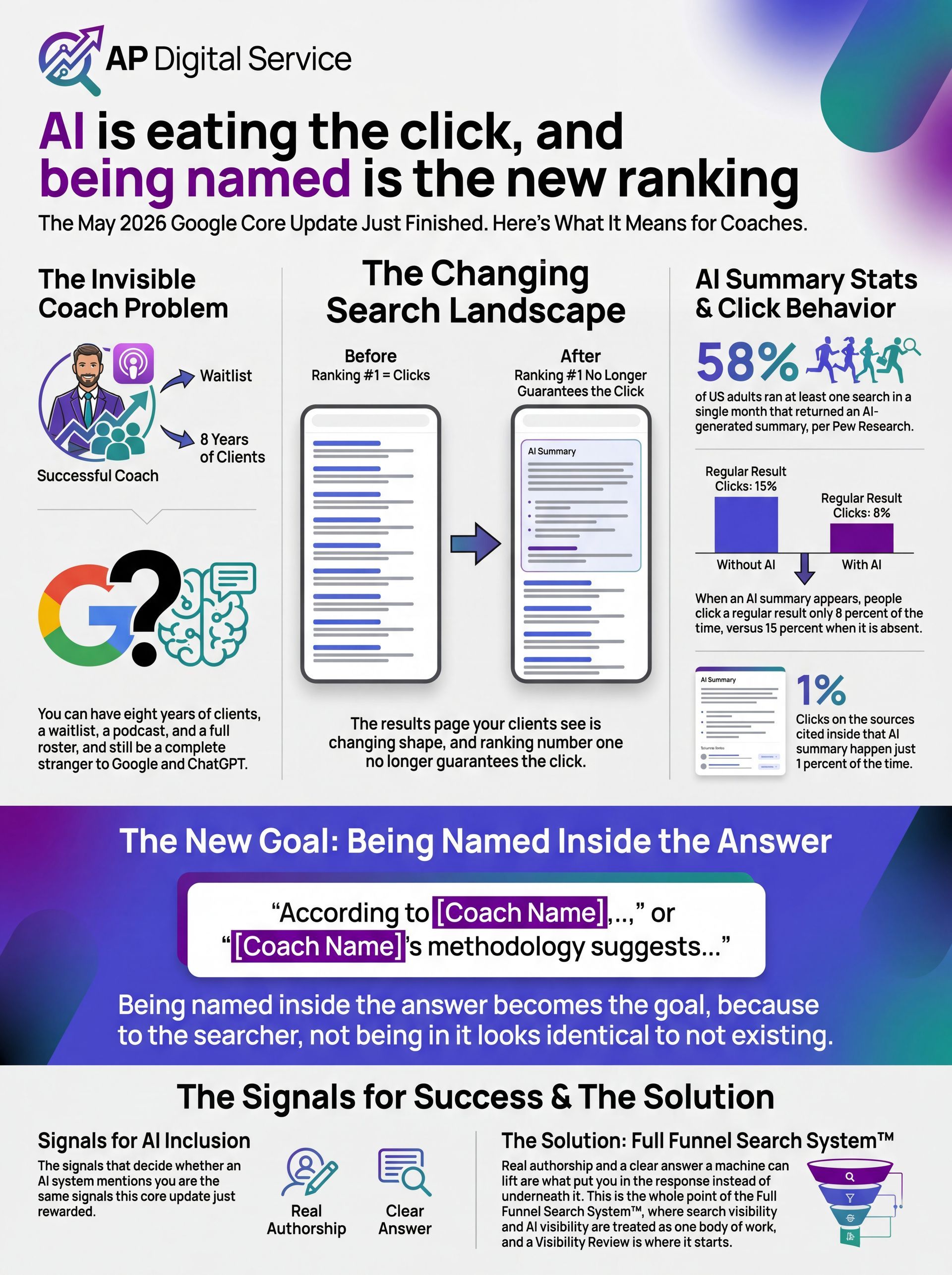
The results page your clients see is changing shape. In a Pew Research Center study that tracked the real browsing data of 900 US adults, 58 percent ran at least one Google search in a single month that returned an AI-generated summary. For most people, AI answers are already part of normal searching, not some future thing.
And when that summary shows up, people click less. Pew found users clicked a regular search result only 8 percent of the time when an AI summary was present, versus 15 percent of the time when it was not. Clicks on the sources cited inside the summary were rarer still, at 1 percent. The answer gets read. The link often just sits there.
Here is what that means for you. When an AI answer sits at the top, ranking number one stops guaranteeing the click, because fewer people scroll down to reach it. A lot of the time, the only impression you get is your name showing up inside the answer the person reads. So being in that answer becomes the goal, because the other option is not being in it, and to the searcher that looks identical to not existing.
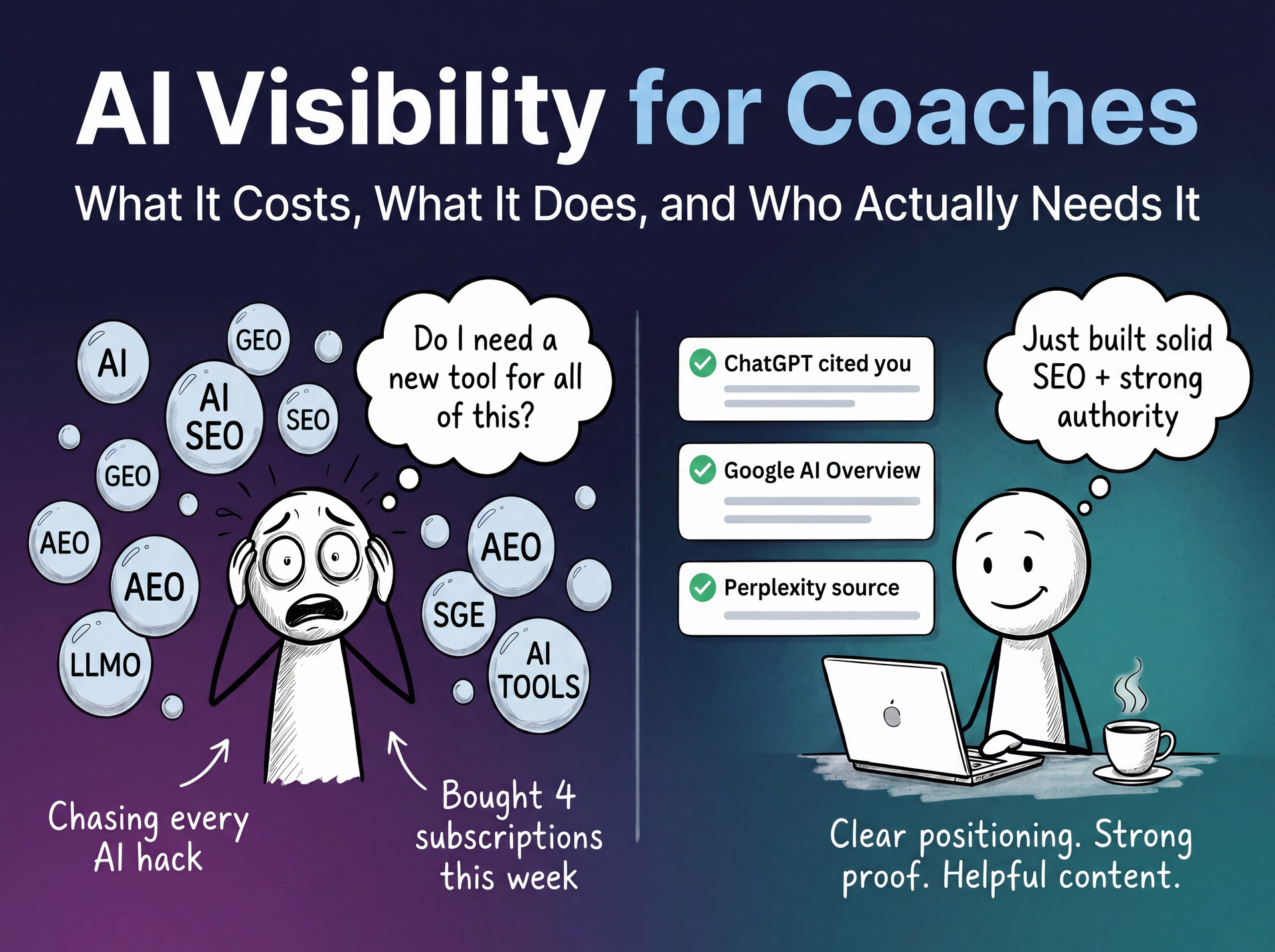
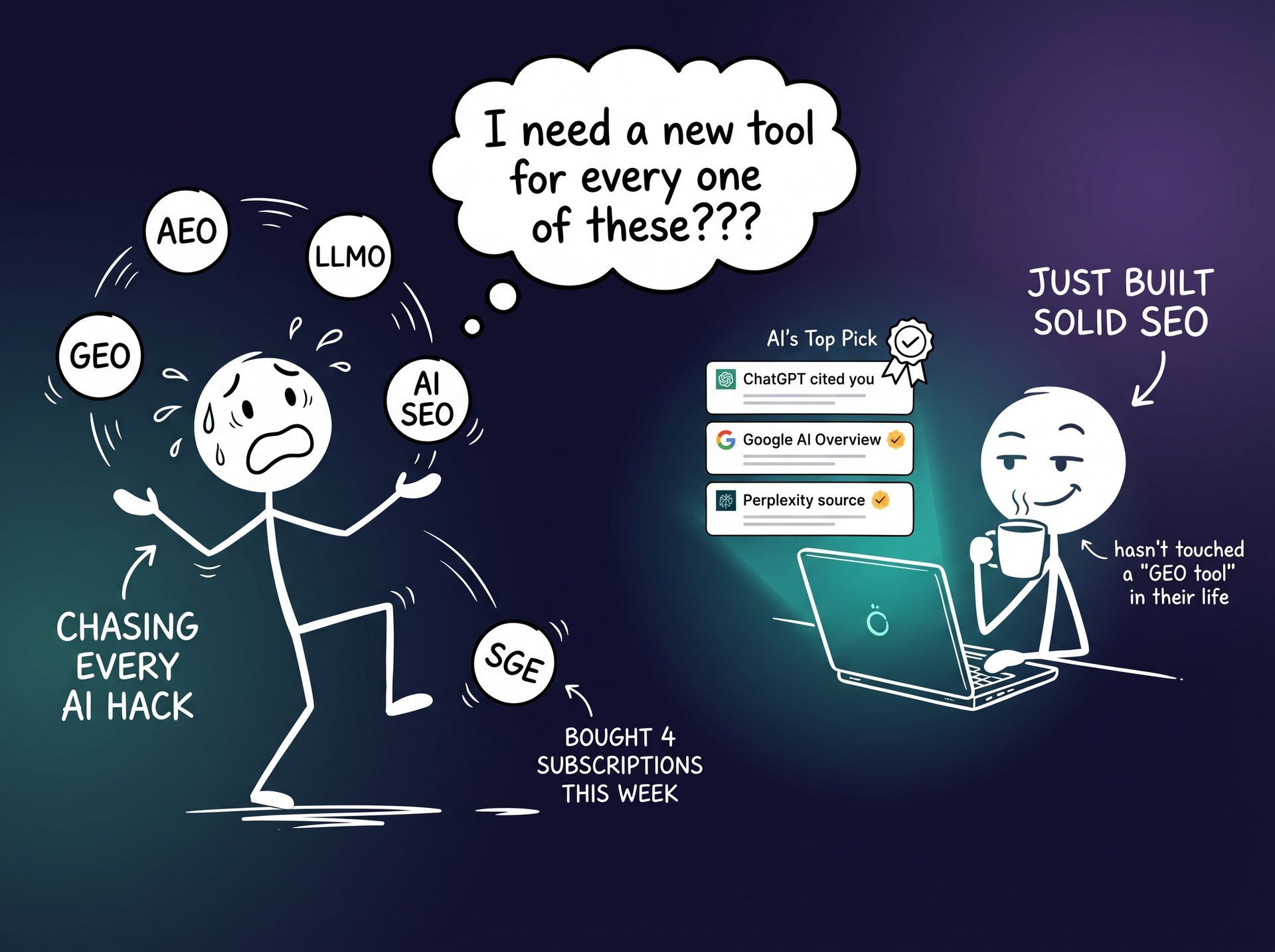
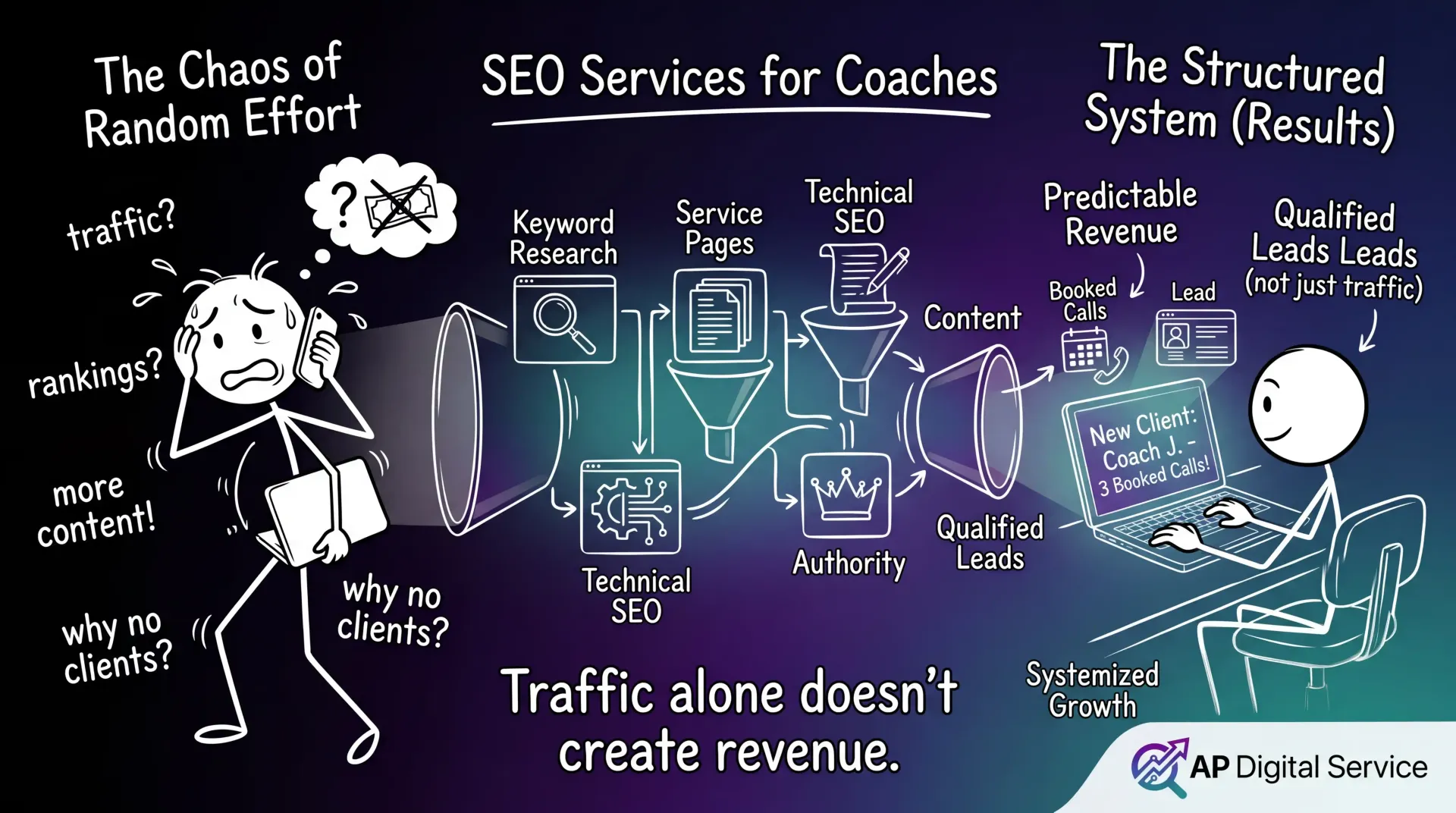
Now the part most coaches have not connected. The signals that decide whether an AI system mentions you are the same signals this core update just rewarded. Real authorship. Real proof. A clear answer a machine can lift and quote. The same story about who you are everywhere it shows up. SEO and AI visibility are not two separate bills fighting over your budget. They run on the same fuel. That is the whole point of the Full Funnel Search System™, and why we treat them as one thing instead of two.
What this actually means for an established coach
You are not a software company or an online store, and most SEO advice was written for one of those. So let me make it specific.
You can have eight years of clients, a waitlist, a podcast, and a full roster, and still be a complete stranger to Google and ChatGPT. Not because you lack proof, but because the proof lives in your inbox and on your calls, where no search system can see it.
The pattern I keep running into is not a proof problem at all. It is a positioning one. A coach tries to make one offer appeal to five different kinds of clients and ends up specializing in none of them. That hurts you in search and in AI answers for the same reason it hurts you in sales: people hire a coach because the coach is a specialist. The ones who became the GOAT of their category got there by being willing to say no to everyone outside it and yes to everyone inside it. That is what makes someone the obvious authority, and authority is exactly what Google and the models are built to identify. A site that says "transformational coaching for ambitious leaders" is trying to be for everyone, and a machine reads that as being for no one in particular.
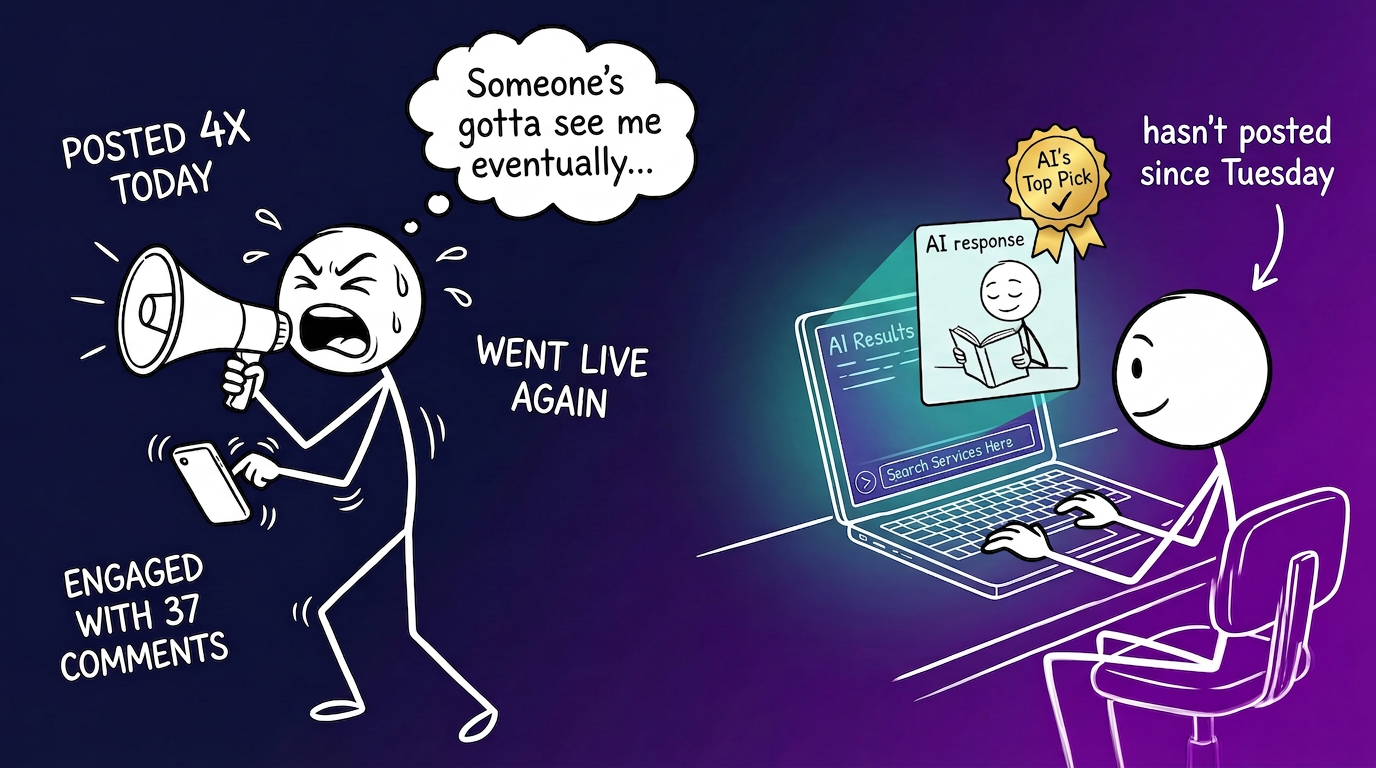
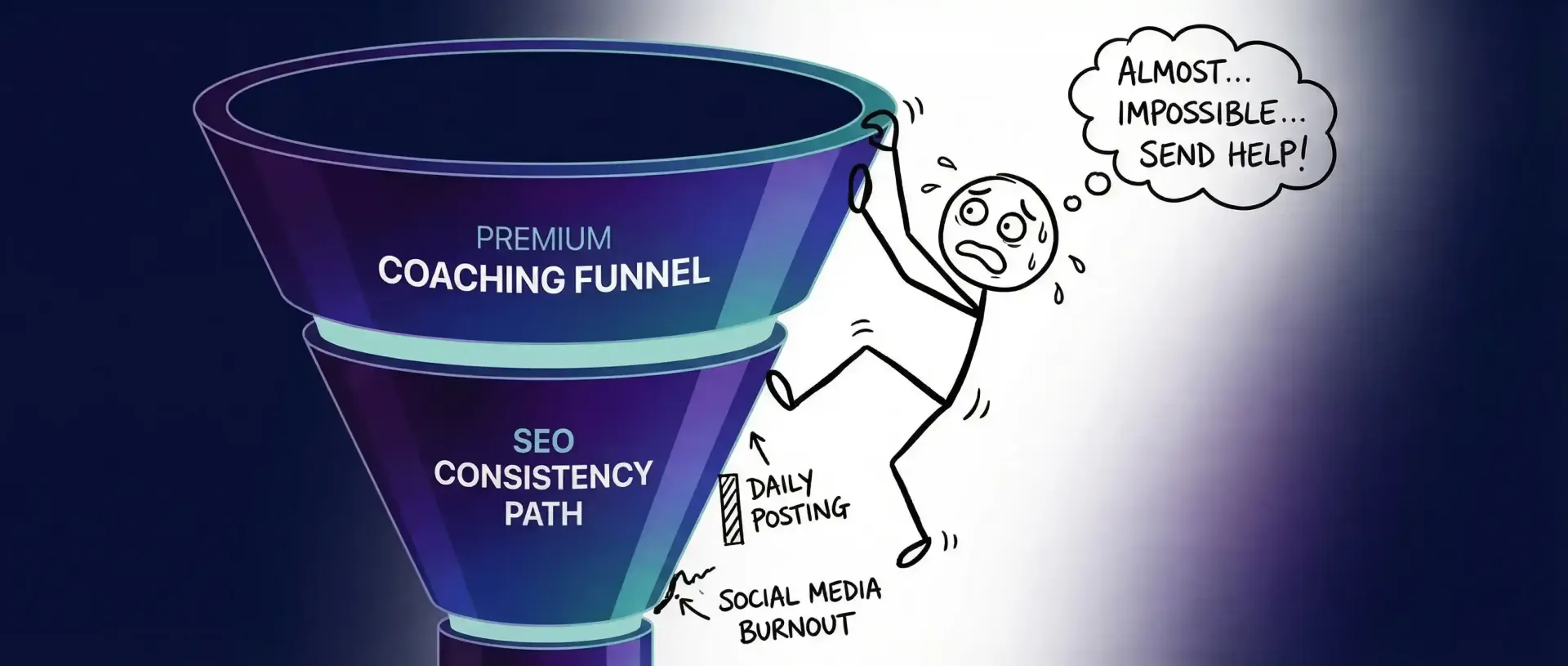
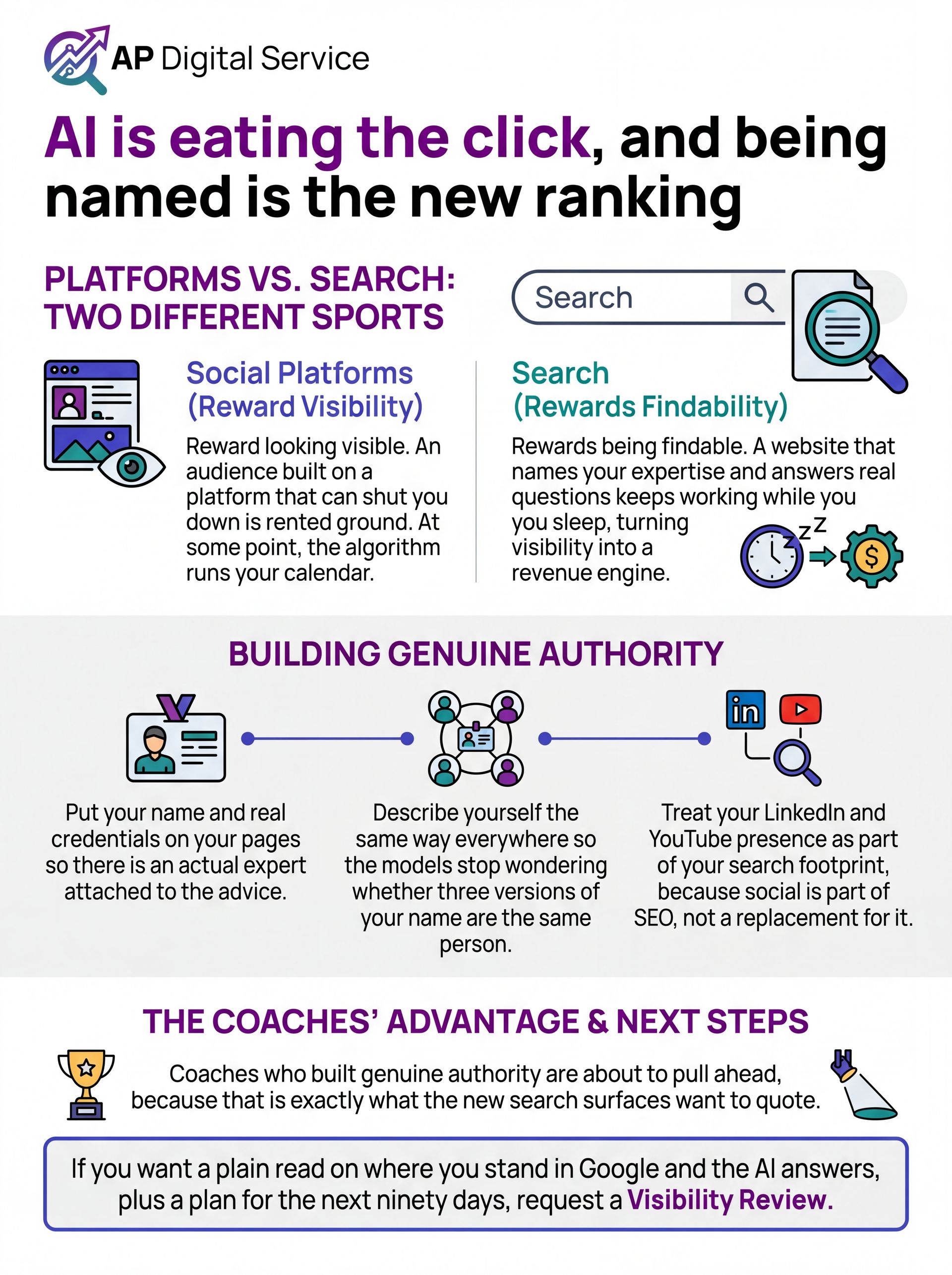
I spent years building an audience on Instagram before I understood any of this, so I am not theorizing about how easy that trap is to fall into. The whole thing sat on a platform that could shut down, or shut me down, at any moment. My audience and the algorithm ran my calendar, and at some point my own schedule stopped feeling like mine. Social platforms reward looking visible. Search rewards being findable. Those are different sports, and a core update is just Google getting better at telling them apart.
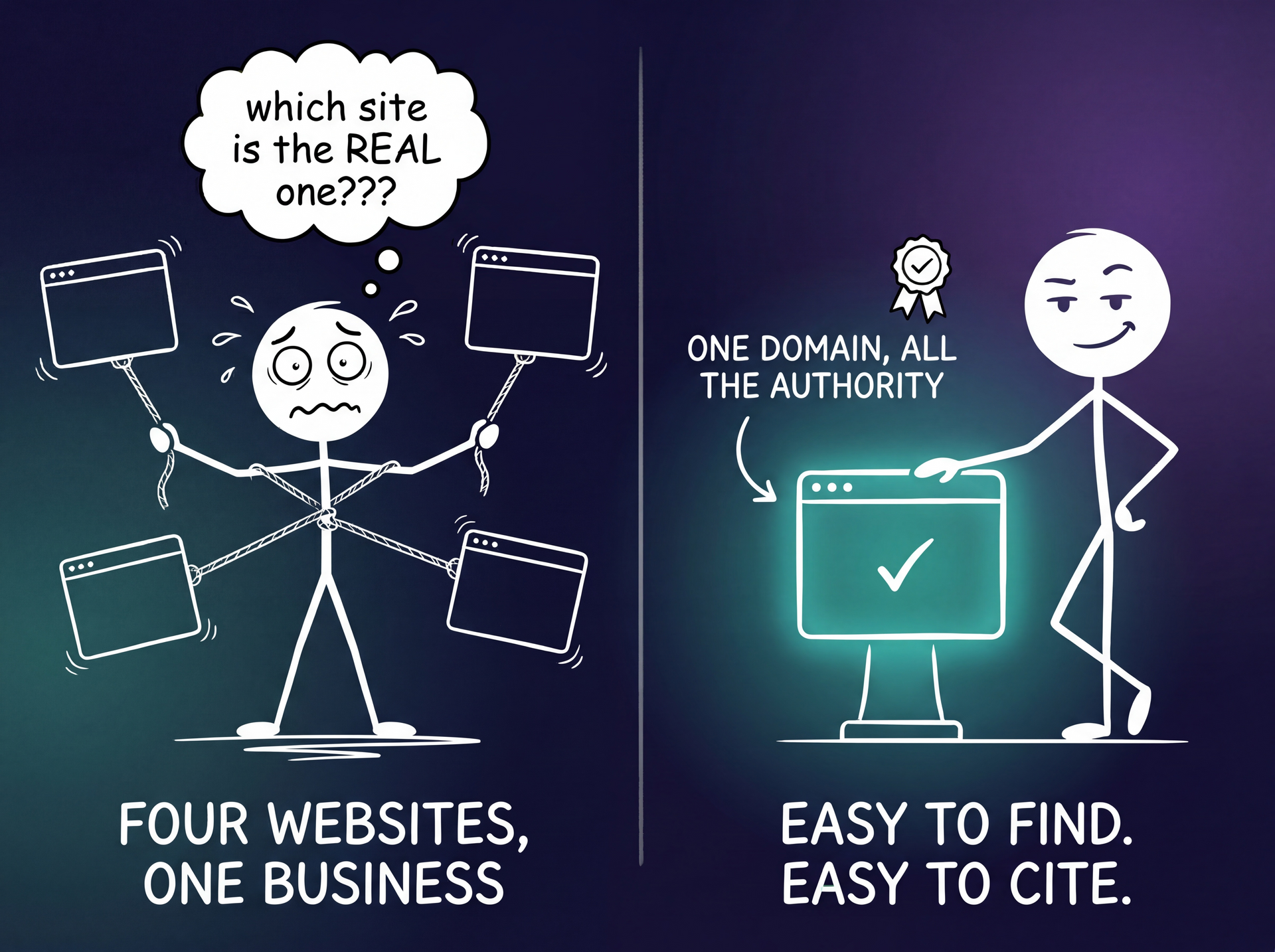
The work after this update is not dramatic. Put your name and your real experience on your pages, so there is an actual expert attached to the advice. Describe yourself the same way everywhere, so Google and the models stop wondering whether three slightly different versions of your name are the same person. Answer the real questions your clients ask, in plain words, near the top of the page. And treat your presence on LinkedIn and YouTube as part of your search footprint, because it is. Social is part of SEO, not a replacement for it.
What technical basics should a coach check?
None of these are dramatic and none of them are new, but a core update is a fine reason to confirm they are handled:
- Your Google Business Profile is complete, accurate, and active. For a local or hybrid coaching practice, it is often the most visible thing you own.
- Your pages load fast and pass Core Web Vitals, especially on a phone, where most people will actually find you.
- Your key pages have structured data, so search engines and AI systems can read plainly what your services are and who runs them.
- Your booking and contact flow works on mobile, because traffic that converts is the only traffic that pays the bills.
What to do this month
- If your traffic dropped, change nothing for a week, then run the clean before-and-after.
- Search your own name and your coaching category inside Google's AI Mode, ChatGPT, and Gemini, and see whether you come up at all.
- Make sure every important page names a real author with real credentials.
- Keep your name, title, and description consistent across your site and your profiles.
- Lead your key pages with a direct answer to the question that page exists to answer.
- Track clicks and booked calls, not impressions. Business impact is the number that matters, and it is the one vanity metrics hide.
Those five are most of what we check in a Visibility Review, because they are what actually changes your standing in regular search and AI answers at the same time.
Frequently Asked Questions
When did the May 2026 Google core update finish rolling out?
It completed on June 2, 2026, after starting on May 21. The rollout took just under twelve days and was confirmed on Google's Search Status Dashboard.
Did the May 2026 core update hurt my coaching website?
It may have moved your rankings, but it did not penalize you. Core updates reassess which pages best answer a search. They do not target specific sites, and a drop is not a punishment.
Should I change my website right now if my rankings dropped?
No. Google recommends waiting at least a week after a core update completes before analyzing your data, then comparing that week against the week before the update began. Reacting mid-rollout usually makes things worse.
Does this update change how I show up in ChatGPT or Google's AI answers?
Indirectly, yes. The expertise and trust signals this update rewards are the same ones that decide whether AI systems mention you. Strengthening one strengthens the other.
What does E-E-A-T mean for a coach?
It stands for experience, expertise, authority, and trust. In practice, it means showing a real, credentialed person behind the advice, backing claims with proof, and answering the searcher's question directly.
Is AI-generated content penalized after the May 2026 update?
No. Google does not penalize a page just because AI helped write it. What matters is whether the page is accurate, original, and genuinely helpful content. AI-assisted content that a real expert reviews and improves is fine. Thin content produced only to chase rankings is what struggles, and a broad core update tends to re-evaluate that kind of content across many sites at once, with or without AI in the mix.
When should a coach bring in outside help?
If your traffic dropped sharply and has not recovered a week after the rollout finished, or you cannot tell whether the problem is your content, your technical setup, or a mismatch with what searchers actually want, that is the point to get an outside read. Someone who is not buried in your business can usually spot in an afternoon what you have been staring past for months.
Where this leaves you
Core updates will keep coming, and the next one will reward the same thing this one did: a real expert, answering real questions, in a way people and machines can both read. Coaches who built genuine authority are about to pull ahead, because that is exactly what the new search surfaces want to quote. The ones treating their website like a digital business card are going to watch the gap widen.
Peter and I built AP Digital Service for one kind of person. The coach who is genuinely good at the work and genuinely helps people, but is stuck working for a platform instead of for themselves, because nobody can find them. Our job is to compound great coaches so they can do what they do best at scale, on ground they actually own.
If you're an established coach and want an outside read on where you actually stand in Google and the AI answers, plus a free plan for the next ninety days, request a Visibility Review.
We will tell you what is working, what is not, and what to do about it.

Founders, AP Digital Service